

For a while, interactivity in connected TV (CTV) advertising seemed to follow a fairly simple formula: giving viewers something to click, scan, or tap would bring engagement with it. The numbers appeared to back this notion up, with interactive CTV ads driving 36% higher unaided recall than standard spots. Then interactive units became standard issue, and between Q1 2025 and Q1 2026, average engagement with them fell by half even as their numbers grew.
It’s a useful and poignant correction for the CTV market. A QR code isn’t a reason to act on its own, nor is an interactive button simply because it’s there. The brands seeing true business impact are giving viewers something they truly want to respond to, then connecting that response to what happens next.
Škoda did exactly that, using CTV Performance and QR codes to deliver 74,000 qualified site visits at an effective cost per visit of just $0.51 through our CTV advertising solutions. Every single visit traced directly back to the biggest screen in the house, recording a 17% bounce rate that proved viewers actively engaged with their electric vehicle lineup. Those are conversion numbers even a search campaign would be proud of.
What Are Interactive CTV Ads?
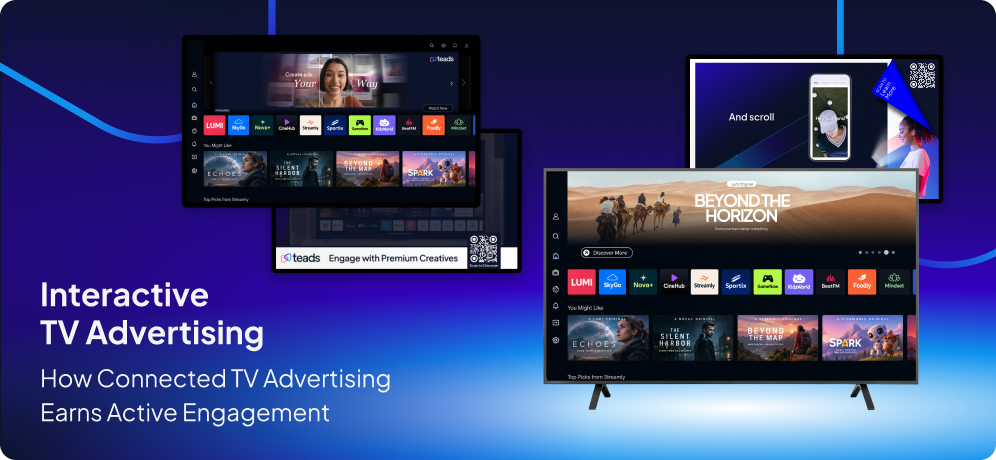
Interactive CTV ads are video and native television formats designed to invite an active viewer response, transforming the living room screen into an interactive touchpoint. Rather than relying on remote navigation, today’s high-performing interactive CTV formats focus on a seamless cross-screen handoff:
- Smart TV HomeScreen Placements: High-attention placements on the native TV interface where viewers choose what to watch. Through partnerships with manufacturers and platforms like TiVo Ads, these native placements can carry shoppable QR codes and expand up to 90% of the screen.
- QR Formats: Dynamic QR codes integrated into high-impact CTV video spots, directing viewers to their smartphones for instant mobile checkout, store locators, or exclusive content drops without disrupting their viewing experience.
- Teads Studio Branded Overlays: Tailored InStream enhancements and visual framing, such as dynamic brand ribbons and campaign messaging, engineered by Teads Studio specifically to maximize impact on the living room screen.
For a deeper foundational view, explore our comprehensive guide on how connected TV advertising works.
Across premium InStream ad breaks, Teads pairs video creative with high-contrast QR overlays engineered for living room legibility. On the Smart TV home screen, where people decide what to watch, CTV HomeScreen placements can carry shoppable QR codes, while our partnership with TiVo Ads delivers native units that expand to fill up to 90% of the screen.
Who Responds to Interactive Connected TV Advertising?
Appetite for interaction in CTV advertising also varies sharply with age. When our UK CTV Pulse research asked viewers which features they’d be open to using in a TV ad, 23% of 18-24-year-olds said they’d try a virtual try-on, and 21% would engage with a brand through a voice assistant like Alexa. Among viewers aged 55 and over, the figure dropped to just 1% for each.
of UK viewers aged 18-24 say they’re open to using a virtual try-on in a TV ad.
Source: Teads 2025 UK CTV Pulse Report
Survey answers deserve a little caution, however, since saying you’d scan a QR code is easier than picking up the phone and doing it, but a generational slope that steep tells you where connected TV advertising is heading. Viewers who grew up tapping their phones and tablets now expect to be able to respond to the TV in the same way, and interactive CTV ads build that response into the CTV campaign itself.
What Gives Viewers a Reason to Respond?
In connected TV advertising, curiosity is usually there already. Our study with the MediaMento Institute found that 71% of viewers who saw a CTV HomeScreen ad wanted to learn more about the brand. The job of an interactive unit is to give that curiosity a frictionless next step.
The CTV campaigns driving real outcomes share three common characteristics:
- An offer or moment that justifies the effort: Carl’s Jr. tied its campaign to a limited-time offer and a series premiere, running QR codes across CTV HomeScreen, CTV InStream, and inRead. Viewers scanned them 745% more often than the market average, and the campaign reached 1.1 million incremental users beyond its linear TV plan, with lifts of 19 points in ad recall and 18 points in purchase intent.
- An action matched to the screen: Asking a viewer to type with a TV remote creates friction. High-response CTV campaigns use the big screen to deliver cinematic impact, then use clean, high-contrast QR creative to seamlessly hand the transaction off to the personal device where buying takes one tap.
- Creative built for the big screen: Teads Studio designs CTV ad formats with branded overlays, skins, and QR placements optimized for television so the interactive element reads clearly from across the room.
What Earns a Response
How to Measure Interactive CTV Ads Beyond the Click
EMARKETER's advice to planners, in its report on the drop, is to judge interactivity on outcomes and attention, with remote clicks kept as a supporting signal. That fits how CTV measurement now works, because a scan or a button press is usually the start of a path that finishes on another screen.
Our campaign with Škoda was measured in active on-site exploration and qualified web traffic, which is about as far from a basic remote-click count as TV measurement gets. We ran it through Teads CTV Performance, serving impressions across high-impact CTV HomeScreen placements with QR code interactivity and tracking web engagement through the Teads Universal Pixel. The result was 74,000 qualified site visits at an effective $0.51 CPV and a 17% bounce rate, demonstrating that big-screen interactive exposures drive direct digital engagement. Across the platform, campaigns optimized this way achieve a 79% lower cost per quality visit than non-optimized CTV.
Attention fills in the rest. Our attention measurement with Lumen Research covers CTV HomeScreen placements, showing how well the creative held viewers' eyes alongside what they did next, and household-level identity links both signals to the same home.
Planning Interactive CTV Ads for 2026
Interactivity works best when there is a clear next step and a closed-loop system to measure what happened afterward. Often, that journey carries on beyond the TV screen and onto a phone, which we explore in our guide to cross-screen connected media.
That becomes harder to manage when campaigns are spread across different markets, screens, and buying environments. Tools like Teads CTV Ensemble bring HomeScreen, InStream, and CTV Performance together with premium digital environments. Media teams can plan the TV exposure and the mobile follow-up and measure real business outcomes around the same campaign inside one seamless workflow.
Ready to connect interactive CTV ads to measurable outcomes with a single omnichannel platform? Explore our full-funnel CTV strategy guide or get in touch to launch your next campaign.