

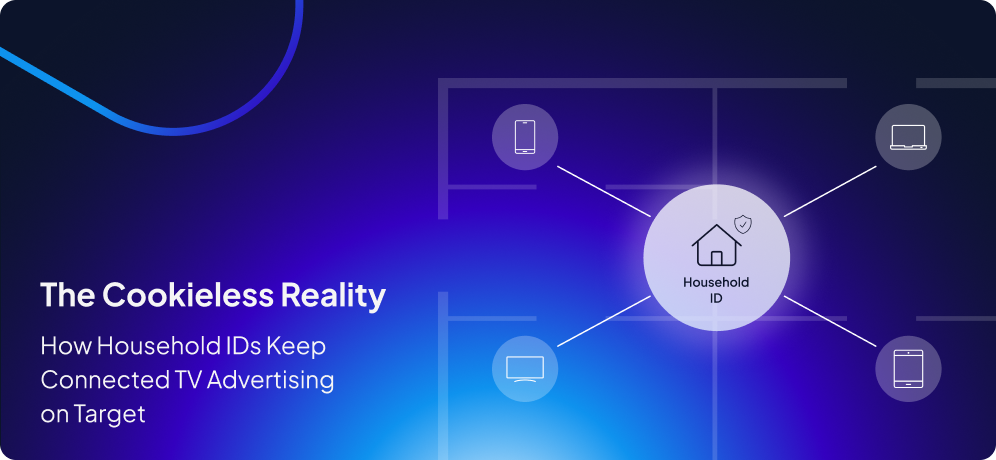
For a decade, digital targeting rested on a single small file. The third-party cookie followed people across the web, powered most audience segments in market, and made person-level addressability feel like a permanent feature of the landscape. That era is closing, with privacy regulation tightening and the identifiers behind it thinning out year by year. Yet connected TV advertising has remained largely untouched by the disruption, because the channel grew up on a different identity architecture altogether. One built natively for omnichannel advertising. Where the web leaned on cookies, Connected TV (CTV) advertising runs on the household, and that difference is becoming one of the channel’s most valuable strategic advantages.
Why Signal Loss Hits Connected TV Advertising Differently
The cookie was a browser-era invention, tied to one user on one device. Television was never going to fit that model. A CTV device belongs to a living room, is shared by everyone in the home, and identifies itself through durable signals like IP address and device ID.
In the channel’s early days, that shared, household-level identity looked like a limitation. It has aged remarkably well. While web advertisers work to replace deprecated identifiers, CTV ads have continued reaching audiences through the same signals they always used.
One assumption is worth examining along the way. Because nearly every streaming service requires a login, advertisers often expect CTV advertising to offer rich, person-level addressability by default. The reality is more nuanced. Most CTV is bought programmatically, around 75% of it, and buyers frequently depend on whatever data publishers pass through the bidstream. The household ID fills that gap with a stable, privacy-conscious foundation to build on.
of CTV inventory is bought programmatically, making household identities critical for addressing the bidstream.
Source: Teads Omnichannel Intelligence
How Household IDs Power CTV Targeting
A household ID groups the devices that share a home into a single addressable unit. The television, the phones, the laptops, and the tablets all resolve to one household, which means CTV targeting can find the right homes and recognize when other screens in those homes come into play.
Connecting identity to behavior
Our approach links this graph to what audiences read and watch. The Teads Omnichannel Graph connects reading behavior in premium editorial environments with viewing behavior on the big screen, built on a curated household and user graph spanning more than 50 million CTV devices and over 100 million users across 25 countries. Layering contextual signals with device and behavioral data creates a high-fidelity proxy for audience targeting through AI-based inference, so campaigns reach the right households with or without user-level identification.
Connected devices, spanning 100M+ users across 25 countries, are linked through the Teads Omnichannel Graph for cookieless targeting.
Source: Teads Proprietary Graph Data
What household-level delivery makes possible
For media buyers, the household ID translates into three practical capabilities:
Attention Becomes the Quality Layer for CTV Measurement
Reaching the right households is half of the cookieless equation. The other half is proving each exposure counted for something, and this is where CTV measurement is maturing fastest. Across the industry, evaluation is moving beyond click-adjacent proxies toward attention, a signal that travels well in an environment with no cookies to track.
We recently expanded our partnership with Lumen Research to bring attention measurement to our CTV offering, starting with the HomeScreen placement across the US, EMEA, APAC, and LATAM. Lumen builds predictive attention models from consented eye-tracking data gathered in more than 50 countries, and applying those models to premium CTV inventory shows advertisers how audiences engage with CTV ad formats on the biggest screen in the house. Attention data pairs naturally with household-level delivery, giving buyers a read on media quality that requires nothing from a third-party cookie.
Together, the two layers reshape what a campaign report can say. A connected TV advertising campaign can now demonstrate that it reached the intended households, earned real engagement, and contributed to outcomes further down the funnel, all inside a privacy-first framework.
Planning CTV Campaigns for a Cookieless Future That Already Arrived
For agencies helping clients navigate signal loss, connected TV advertising deserves a central place in the conversation, precisely because its identity model was never dependent on the thing being deprecated. The channel offers durable targeting through household IDs, behavioral and contextual audiences that work at scale, and an attention-based measurement layer that keeps improving.
The opportunity now is to treat the household as the planning unit for full-funnel video strategy, letting connected TV advertising anchor reach while the other screens in the home carry the response. Advertisers who make that shift early will spend the coming years building on a stable foundation while much of the industry is still rebuilding its identity stack.
Want to see how household-based targeting could work for your campaigns? Get in touch to explore our CTV and omnichannel solutions.