

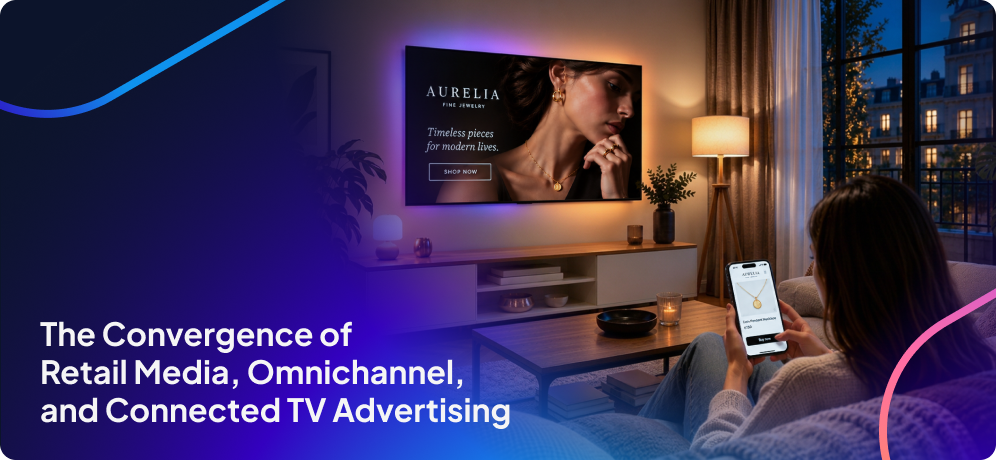
In June, Walmart agreed to pay a reported $1.4 billion for Vibe.co, a self-serve Connected TV (CTV) advertising platform, its biggest advertising acquisition since it bought the television maker Vizio. That same month, DoorDash folded its ads business across three continents into a single commerce media platform serving more than 400,000 advertisers. Neither company has any ambition to be in entertainment. They’re following their advertisers’ money, which is moving beyond the digital shelf, and a growing share of it is arriving in CTV advertising. EMARKETER expects retail media to account for one in five US CTV ad dollars by 2028.
For brands running omnichannel campaigns, the interesting question is what becomes possible when verified purchase data starts deciding what plays on the biggest screen in the house.
Why Retail Budgets Are Moving Into Connected TV Advertising
Retail media built its business on sponsored listings and on-site placements, and it built it fast because retailers hold something the rest of the industry has spent multiple decades approximating. They know better than anyone what households buy. A retailer’s own site, though, only has so much room, and it only reaches people who’ve already arrived with intent. Growth has to come off the property, which is why EMARKETER’s forecasts show offsite retail media in the US growing at nearly three times the pace of onsite.
Connected TV (CTV) advertising is the natural destination for those budgets, because each side has what the other lacks. Putting it plainly, CTV needs retail media’s data, especially with third-party identifiers fading, and retail media needs CTV’s reach. This is because on-site ads meet shoppers at the moment of purchase, and full-funnel brand building has to find them well before that. Put purchase data behind the big screen, and connected TV advertising becomes television that knows its audience and can prove what happened after the break.
Retail Brands Got to CTV First
Retailers were early to CTV as advertisers, long before they became media owners. Our State of Video & CTV study with the MMA found retail and e-commerce brands leading every industry in CTV adoption, with 96% already running CTV campaigns while balancing premium reach with shopper-driven content.
of retail and e-commerce marketers already run campaigns on CTV, the highest adoption of any industry.
Source: Teads x MMA, State of Video & CTV Study
That number is rather significant, coming from the sector that lives closest to the transaction and judges its media in weeks rather than quarters. It went to the big screen early because the big screen could already show its work. Demand is following on both sides of the trade. When we asked marketers across every industry which video placements and CTV ad formats interest them most, retail media video came first at 64%, with shoppable video close behind at 52%.
What Purchase Data Changes About CTV Targeting
For an enterprise brand, plugging retail data into connected TV advertising changes three things in practice:
- CTV targeting built on real baskets: Audiences come from verified purchase behavior rather than inferred interest, so a beverage brand reaches households that buy in the category, and a pet food brand finds homes that recently became pet owners to the weekly shop.
- A connected path between inspiration and checkout: A big-screen exposure can carry through to shoppable and interactive formats on personal devices, so the interest sparked during an ad break lands on a screen where buying takes one thumb.
- CTV measurement in commerce terms: Closed-loop reporting connects CTV ads to basket additions, sales lift, and category share, the language commerce teams already work in, alongside the reach and attention metrics brand teams rely on.
This is the thinking behind our CTV Performance offering, which treats the living room as a channel you can optimize toward outcomes as readily as reach.
Planning an Omnichannel Response
None of this means every brand should rush to rebuild its media plan around retailer data. It does mean the wall between the trade budget and the brand budget is looking more like a habit than a necessity. The advertisers experimenting now tend to start small, with one retail data partnership, one connected cross-screen plan, and a measurement framework agreed before launch rather than argued about after.
The Retail Loop
The retailers spending billions to get into the living room have settled at least one old debate: the big screen is now somewhere commerce happens, and their own money says they believe it. The brands that plan connected TV advertising that way, inside one omnichannel framework, will be reading results their competitors can't see yet.
Ready to put purchase data to work on the big screen?
Get in touch to explore our CTV and omnichannel solutions.