

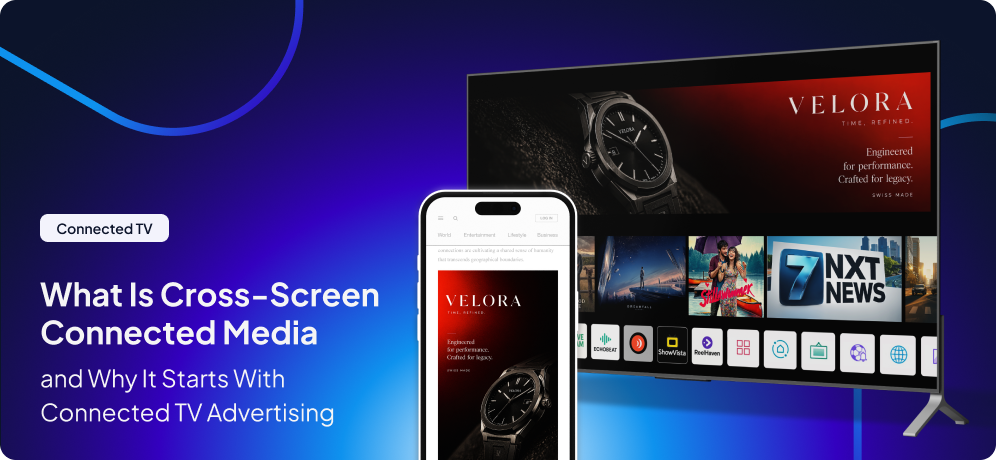
Picture a typical evening in any living room around the world. A streaming show plays on the TV while a phone sits within arm’s reach, picked up during every lull to message friends, check a price, or search for something that appeared on screen. That evening ritual, repeated in millions of households, is why cross-screen connected media has become the organizing idea behind modern video strategy and why connected TV advertising sits at the center of it. The big screen sparks interest at scale, and the personal screen carries that interest forward into action.
Marketers who plan for that behavior treat TV and mobile as one continuous experience. Those who plan each screen separately leave the connection between them to chance.
Defining Cross-Screen Connected Media
Cross-screen connected media is the practice of planning, activating, and measuring video as a single system across every screen a person uses, with Connected TV (CTV) advertising working alongside mobile, desktop, and tablet instead of running in its own silo.
Framed that way, each screen takes on a specific job. A CTV exposure becomes the opening move in a sequence. The follow-up might be a native video ad on a news site the next morning, a display placement that picks up the same creative idea, or a search the viewer runs while the ad is still playing. Each touchpoint builds on the last, so the story a person experiences feels continuous even though it spans several devices.
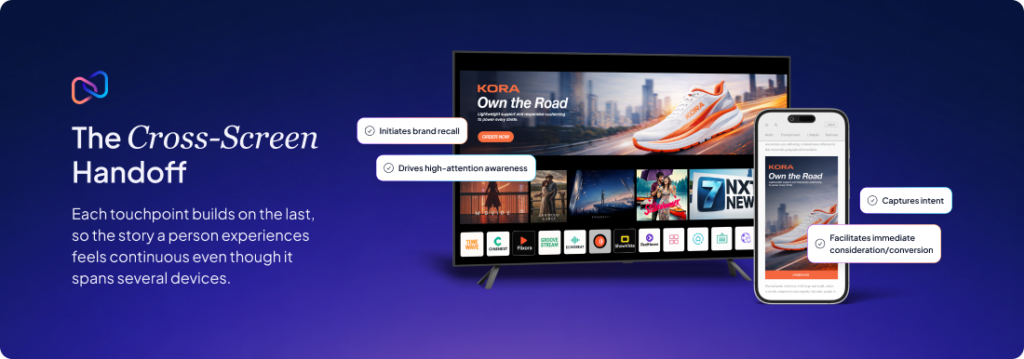
It also happens to be how people already watch. EMARKETER’s analysis of 2026 CTV trends notes that viewers move fluidly across subscription streaming, ad-supported apps, free streaming channels, and the Smart TV home screen without ever thinking of them as separate environments. Audiences live in one continuous world of content, so cross-screen connected media simply asks advertisers to plan the way their audiences watch.
Why Connected TV Advertising Anchors the Cross-Screen Experience
Every connected system needs an anchor, and for video that anchor is the television. CTV ads run full-screen and sound-on in the most premium environment a brand can occupy, which makes them the natural starting point for a story that continues on smaller screens.
Media budgets are being redrawn around that logic. EMARKETER forecasts that about 6 in 10 US TV ad dollars will flow to CTV by 2029, up from roughly 4 in 10 in 2025, and our State of Video & CTV study with the MMA found that senior marketers now rate CTV as a top environment for reach, audience targeting, and brand safety, ahead of linear television. Investment follows attention, and attention has settled onto the biggest screen in the house.
of total US television ad dollars flowing to CTV by 2029 (up from ~40% in 2025)
Source: EMARKETER Forecasts
What has changed is the expectation attached to that investment. Brands committing serious CTV advertising budgets want campaigns that connect to everything else they run, which is precisely the promise of a cross-screen approach.
How Cross-Screen Connected Media Works in Practice
Teads CTV Ensemble brings those parts under one roof, so CTV campaigns and the screens around them are orchestrated in one place instead of four.
When those parts click, the effect shows up in the numbers. Nestlé’s PURINA PRO PLAN campaign in Germany carried one creative idea for dog owners across CTV HomeScreen and inRead placements, and interactive shoppable formats. The brand saw lifts in awareness (+19%), favorability (+31%), recommendation (+37%), and purchase intent (+44%) compared to single exposure. The point of the example is an effective sequence design, since each screen picked up the momentum the previous one had built.
What Connected TV Advertising Means for Cross-Screen Planning
For media planners, the practical shift is to brief every connected TV advertising campaign with a next step in mind. Before a spot runs, the plan should already answer what the viewer will encounter on their phone or laptop afterward, and how the two exposures will be measured together. CTV ad formats that invite interaction, such as QR-enabled creative and shoppable units, shorten the distance between screens even further by letting the handoff begin while the ad is still playing.
The brands seeing the strongest results from connected TV advertising are the ones treating it this way, as the start of a journey that other screens complete. It is the same thinking behind our omnichannel approach, where one platform plans and measures the whole sequence. Viewing behavior became connected years ago, media planning is catching up, and the advertisers who close that gap first will get more from every screen they buy.
Want to see how a connected cross-screen strategy could work for your brand? Get in touch to explore our omnichannel solutions.