

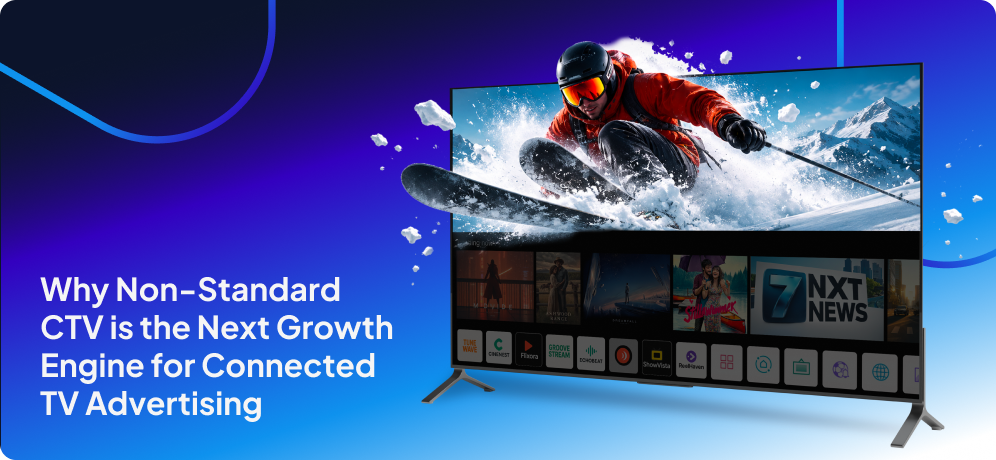
When you switch on a Smart TV, the first thing you encounter is not a streaming show or a mid-roll ad, it’s the operating system’s homescreen. That moment, repeated hundreds of millions of times every evening across living rooms worldwide, has become one of the most valuable pieces of media real estate in digital advertising. Before a viewer commits to an app or selects a series, they spend active, attentive minutes browsing the television interface.
That discovery window occurs entirely outside the traditional 30-second commercial break that television advertising was historically built around. As audience attention fragments across subscription services, modern Connected TV (CTV) advertising has evolved beyond the stream. Native formats like the Smart TV Home Screen give brands unmissable, front-page positioning, delivering upwards of a 2.3x uplift in ad awareness against standard video norms. Crucially, advancements in automated buying now allow these high-impact native units to trade programmatically at scale, transforming non-standard CTV into a foundational growth engine for media plans.
What Are Non-Standard CTV Ad Formats?
Non-standard CTV ad formats are connected TV advertising units that run outside the traditional commercial break. In December 2025, IAB Tech Lab published the six-format CTV Ad Portfolio, giving buyers and sellers shared definitions for each one:
- Pause ads: Appear when a viewer pauses what they’re watching.
- Menu ads: Sit within a streaming app’s menus and browsing screens.
- Screensaver ads: Run when the TV is left idle.
- In-scene placements: Brand elements added into the content itself.
- Squeezebacks: Shrink the program to make room for the ad alongside it.
- Overlays: Sit on top of the content while it plays.
Sitting above all in-app environments is the Smart TV Home Screen.
Because they live at the operating system level, they also reach everyone streaming on an ad-free subscription, a point we explored in our look at how CTV is expanding beyond InStream.
Within our global ecosystem, Teads delivers direct, premium access to CTV HomeScreen across leading Smart TV manufacturers and operating systems, including LG, V (Formely known as VIDAA), Samsung, Google TV, Whale TV, Titan, and TiVo.
Why Non-Standard CTV Ads Have Been Hard to Scale
Until recently, these formats were fairly difficult to buy at scale. When IAB Tech Lab invited the industry to submit CTV formats for standardization, it received more than 100 different formats from 36 companies, most with their own specs and buying requirements.
The same IAB research found that 75% of CTV inventory trades programmatically, while 92% of the most innovative formats were only available through direct deals. Running them across several platforms meant separate negotiations and separate creative, so for most connected TV advertising campaigns, the 30-second spot remained the practical default.
of the most innovative CTV ad formats were only available through direct deals, while 75% of CTV inventory trades programmatically.
Source: IAB Tech Lab
Executing a global campaign across multiple television manufacturers required separate commercial negotiations, distinct technical specs, and fragmented reporting for each OEM. For most media buyers, standard 15- and 30-second in-stream video remained the only practical default.
That friction has dissolved. As the industry adopted standardized programmatic buying signals, Smart TV placements moved out of manual silos. Through platforms like Teads Ad Manager, media buyers can now plan, target, and measure CTV HomeScreen placements across top television operating systems inside the exact same automated workflows used for in-stream video.
Creative Insights: The Heineken CTV HomeScreen Study
Heineken wanted to know which creative choices worked best on the home screen, so we ran a multi-market creative study with the brand across its European HomeScreen campaigns, and each creative choice moved a different metric:
- Full-screen video for recall: Full-screen HomeScreen video reached 97% ad recall.
- Split-screen for the message: Split-screen formats, which keep part of the menu in view, delivered up to a 100% lift in message association.
- 10 to 15 seconds over six: Ads of 10 to 15 seconds outperformed six-second versions on upper-funnel metrics.
ad recall for full-screen CTV HomeScreen video in Heineken’s multi-market creative study.
Source: Teads x Heineken CTV HomeScreen Study
Each format suited a different job, which suggests non-standard formats in connected TV advertising get the most from a brief of their own, with lengths and layouts set for the screen. Teads Studio builds HomeScreen and other CTV ad formats to those specs and can adapt a brand’s existing assets, so a campaign doesn’t need a separate production for every placement.
How Leading Brands Are Using Non-Standard CTV
- Cartier: Ran a bespoke 3D HomeScreen campaign across Smart TVs and generated more than 12 million impressions.
- IONIQ Skincare: Paired CTV HomeScreen with InRead retargeting and saw a 38.5% higher click-through rate in the retargeting phase, along with a 6% incremental sales lift.
- Omnichannel campaigns: Our research has found that campaigns including CTV HomeScreen deliver 65% higher brand recall and 2x higher purchase intent than single-channel approaches.
The Smart TV Homescreen Advantage:
Planning Non-Standard CTV Ads Alongside InStream
Non-standard formats work best inside a connected TV advertising plan that also includes InStream, since each reaches viewers at a different point in the evening and a household may meet them in any order. CTV Ensemble brings HomeScreen and InStream into one workflow with shared creative and audience intelligence, so the same CTV targeting applies across every placement and household-level identity keeps frequency in check.
CTV measurement can then read each format on its own terms while tracking shared outcomes, with attention measurement from Lumen Research on HomeScreen and CTV Performance connecting CTV campaigns to site visits and other lower-funnel results.
The creative will need to keep improving as the formats spread. EMARKETER expects more brands buying pause ads to test the format's novelty, and viewers say they're most receptive to pause ads that offer something useful, such as an offer they can save or a recommendation tied to what they're watching. Planning all of it through a single connected TV advertising platform keeps those formats, the InStream spot, and the measurement in one place.
Ready to expand your CTV strategy beyond the commercial break? Explore our comprehensive Connected TV Pillar Hub or contact Teads today to launch your campaign.