

When most people think of connected TV (CTV) advertising, they picture a 15 or 30-second video spot running before or during a streaming show. That’s instream CTV, and it’s still the backbone of most CTV media plans. Completion rates above 95%, full-screen delivery, sound on by default. It works, and it will continue to work.
Connected TV (CTV) advertising refers to the delivery of digital video ads within streaming environments on internet-connected televisions.
What’s changing is not the relevance of instream, but the role it plays within a broader system.
CTV advertising is no longer defined by a single format. It’s defined by how brands show up across a sequence of moments in the viewing experience.
It’s becoming a broader ecosystem of attention points – before content starts, during viewing, and even beyond the TV screen itself.
From HomeScreen placements that capture attention before content begins, to interactive formats that create immediate engagement and drive second-screen action, to shoppable overlays that turn a lean-back environment into a consideration moment – CTV is expanding into new formats and reaching consumers at moments that were previously out of reach.
The opportunity is not to move away from InStream. It’s to extend it.
Connected TV Advertising Is No Longer Just the Ad Break
Traditional CTV advertising has been centered around the ad break. But viewers don’t only engage with their TV when content is playing.
There are distinct moments in the viewing experience, and each creates a different opportunity for brands to connect.
The First Impression: When the TV is Turned On
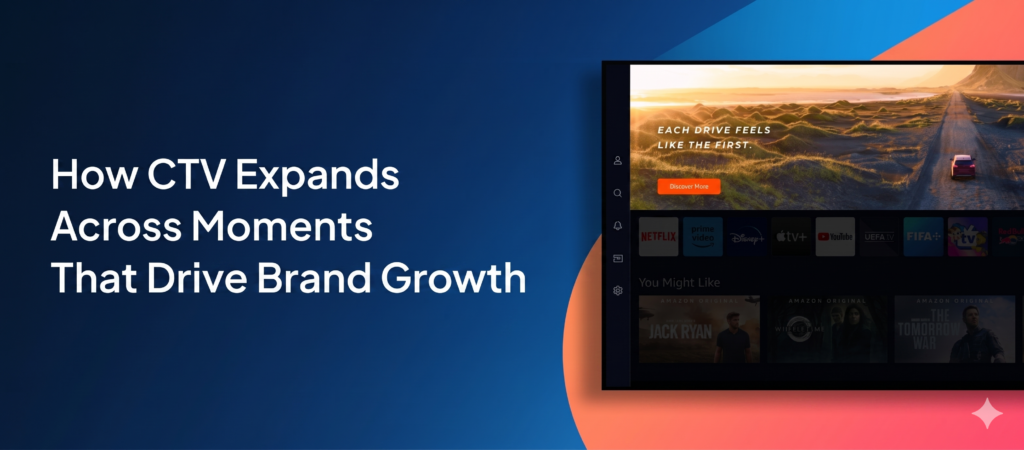
CTV HomeScreen placements capture attention the moment viewers turn on their TV – before content begins. This is a fundamentally different moment: users are navigating, deciding, and more open to discovery.
It also extends reach beyond ad-supported inventory. Households on ad-free tiers can still be reached because the placement sits at the operating system level, not within an app.
A study with MediaMento showed that HomeScreen ads achieved a 48% attention rate and significantly outperformed skippable pre-roll formats in both attention and recall, reinforcing the value of capturing that first moment of engagement.
The Viewing Moment: Lean-Back, Full Attention
During content consumption, instream remains the foundation.
Delivering full-screen, sound-on experiences, CTV InStream combines television’s scale and storytelling power with digital precision. This is where brands build awareness and emotional connection at scale.
What’s newer is the ability to act on attention while it’s still present.
Interactive and shoppable formats enable viewers to engage immediately – through QR codes, overlays, or remote-enabled interactions – creating a direct path from exposure to action.
Performance Layer: Connecting Exposure to Outcomes
CTV Performance campaigns use InStream in combination with measurement (Universal Pixel, household graph, ML optimization) to optimize toward mid- and lower-funnel outcomes and attribute site visits to CTV exposure, ultimately improving retargeting possibilities.
This is where CTV starts to connect with the second screen and directly to lower-funnel outcomes – leads, add to cart, and purchase.
Each of these experiences creates different opportunities for brands to go beyond passive video delivery and generate more moments for attention, interaction, and measurable response across the consumer journey.
What is often referred to as “non-standard” CTV is simply advertising that happens outside the traditional ad break – but in reality, these formats represent something more important: new entry points into the consumer journey.
Why Connected TV Advertising Is Expanding Beyond Instream
Several forces are driving this evolution – not because one format is replacing another, but because the ecosystem itself is expanding.
Fragmentation of Viewing Environments
The first is audience access. Not every viewer watches ad-supported content. Millions of households pay for ad-free tiers on subscription platforms.
HomeScreen advertising reaches these audiences because it lives within the TV operating system itself, outside of any app. For brands looking to extend their CTV reach beyond ad-supported inventory, that’s a meaningful incremental audience.
Attention Is Not Uniform
The second is attention quality. Not every impression carries the same weight, and not all moments drive the same outcome.
A study with the MediaMento Institute found that CTV HomeScreen ads achieved a 48% attention rate, outperforming skippable pre-roll by 16%. Unaided recall hit 50%, aided recall reached 84%, and 80% of exposed viewers said the ads enhanced brand value.
EMARKETER’s 2026 CTV trends analysis describes the home screen as “a more effective route to performance”. This is why high-attention entry points like the HomeScreen are gaining importance within the overall mix.
Engagement Is Becoming Actionable
The third is engagement rates. Interactive CTV formats are gaining traction because they introduce something traditional TV never offered: immediate response.
Interactive CTV ad engagement nearly doubled in a single year, reaching 1.94% in Q2 2025 according to EMARKETER and BrightLine data. QR code usage in CTV ads has grown more than 3x year-over-year (Innovid 2025 CTV Insights report), and agencies are scaling their spending on interactive formats accordingly.
Performance Expectations Are Rising
And the fourth is performance accountability. Advertisers are under increasing pressure to prove outcomes – not just delivery. With Teads CTV Performance solution, campaigns can now be optimized toward measurable outcomes such as qualified visits, engagement, and sales. Success stories using the performance algorithm have seen a 79% lower cost per quality visit and 3.25x more visits compared to non-optimized CTV campaigns.
What Brands Are Seeing in Practice Across CTV Formats
These formats extend what instream can deliver, unlocking additional reach, engagement, and measurable outcomes.
Cartier launched its first 3D CTV HomeScreen campaign and generated over 12 million impressions, using the format’s visual scale to showcase products in a way that a pre-roll spot couldn’t replicate.
Audi tapped into CTV Performance, by combining InStream placements with creatives that invited viewers to see more on the website. Using Teads’Universal Pixel, site visits were tracked following CTV exposure, enabling measurement of post-exposure behavior across devices. The -60% CPQV vs objective confirms how CTV exposure can be directly connected to measurable lower-funnel behavior.
IONIQ Skincare paired CTV HomeScreen with InRead retargeting and saw a 38.5% higher CTR in the retargeting phase, with a 6% incremental sales lift.
Our MMA 2025 State of Video & CTV study shows strong marketer interest in these newer formats. Among senior marketers surveyed, 51% expressed interest in CTV HomeScreen and 52% in shoppable video, putting both formats on par with InStream (61%) for planned investment. That’s notable. A year or two ago, most of these formats were experimental line items. They’re now part of the core CTV conversation.
How CTV Formats Fit Into a Connected TV Advertising Strategy
The most effective CTV strategies are not built around choosing formats, they’re built around combining them.
Instream CTV remains the foundation: high completion rates, broad reach, proven brand lift. Non-standard formats layer on top of that foundation and extend what connected TV advertising can deliver.
HomeScreen extends reach to audiences that instream alone cannot access. Interactive formats engage viewers who would otherwise watch passively. CTV performance optimization connects the living room to the website.
When combined in an omnichannel campaign, the results compound. Our research shows that omnichannel campaigns including CTV HomeScreen placements deliver 65% higher brand recall and 2x higher purchase intent compared to single-channel approaches. That’s the case for treating non-standard CTV as a core part of the plan rather than an add-on.
CTV Advertising Is Bigger Than the Ad Break
CTV Advertising is about how brands show up across the full viewing experience – capturing attention, reinforcing messages, and creating opportunities for action at different moments.
The next phase of growth in CTV advertising won’t come from buying more pre-roll inventory. It will come from using the full canvas of the TV screen, applying smarter targeting to reach viewers in moments where attention and intent are highest, and holding those campaigns accountable for measurable results.
The data supports it, the results prove it, and marketer adoption is accelerating. For brands and agencies building their 2026 CTV strategies, the ad break is the starting point, not the ceiling.
Because in a fragmented media landscape, performance doesn’t come from choosing one format over another. It comes from connecting them.Want to explore how to activate across CTV moments and drive measurable outcomes?
Get in touch with our team.