

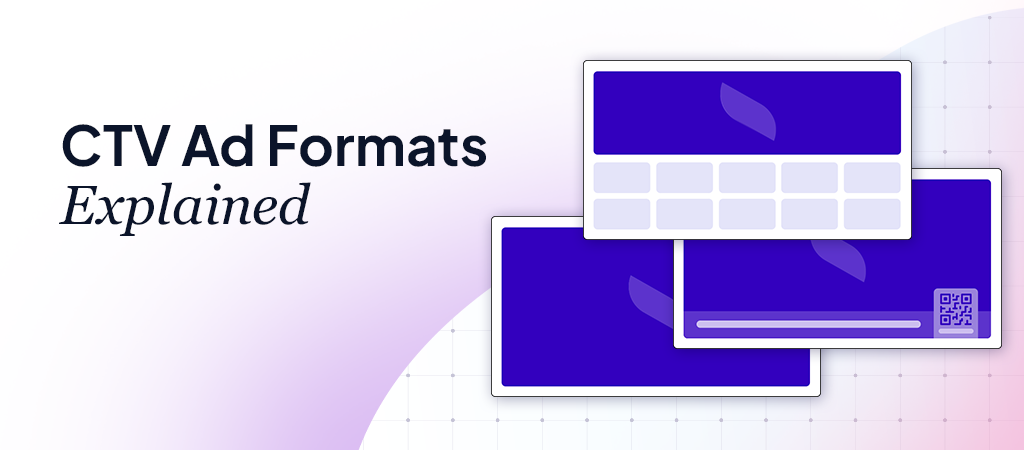
Connected TV (CTV) advertising gets treated as one thing in most planning conversations. In reality, it spans multiple moments and experiences across the viewing journey. There’s the HomeScreen placement that appears before a viewer selects anything to watch, the InStream video spot that runs inside streaming content, and a performance-optimized solution that tracks the exposure from the TV ad to a website visit or other actions. Each plays a different role, reaches audiences in different moments, and contributes differently across the funnel.
This guide breaks down the main CTV advertising experiences available through our platform, explains where each one performs best, and helps media buyers understand how they work together within a connected TV advertising strategy.
CTV HomeScreen Reaches Audiences Before They Press Play
CTV HomeScreen is a fundamentally different kind of placement. Rather than appearing inside streaming content, HomeScreen sits within the smart TV’s operating system, on the first screen viewers see when they turn on their television.
That distinction has a practical consequence that matters for media buyers. HomeScreen reaches audiences that traditional instream CTV ads cannot, including households on ad-free subscription tiers. Not everyone watches ad-supported content, but everyone navigates their TV’s home screen. Our 2025 CTV Pulse report found that ad-supported CTV viewership continues to grow, but a meaningful share of viewers still subscribe to ad-free plans. HomeScreen fills that gap.
Through partnerships with LG, Hisense, VIDAA, and Google TV, our HomeScreen inventory now reaches over 500 million TV screens in more than 50 countries. The format supports static, video, and 3D creative, and more than 1,500 campaigns have run on the platform since launch.
The attention case
A study with the MediaMento Institute found that CTV HomeScreen ads achieved a 48% attention rate, outperforming skippable pre-roll by 16%. Three-dimensional formats captured attention 29% faster. Unaided recall reached 50%, aided recall hit 84%, and 80% of exposed viewers said these ads enhanced brand value.
When combined with other channels in an omnichannel campaign, the results compound. HomeScreen placements deliver 65% higher brand recall when paired with other formats and 2x higher purchase intent.
When to use it
HomeScreen is effective for brand storytelling and awareness campaigns where you want to extend your reach beyond ad-supported inventory. It’s also well suited for tentpole moments like product launches or major cultural events, where high-impact creative on the first screen can anchor a broader campaign.
CTV InStream Is the Foundation of Connected TV Advertising
CTV InStream is what most people picture when they think of connected TV advertising. These are 15 or 30-second video ads served as pre-roll or mid-roll within streaming content on apps and thousands of other ad-supported services.
The viewer experience mirrors traditional television with full-screen, sound-on, non-skippable delivery. But the buying, targeting, and measurement are digital. Industry benchmarks show CTV ads achieve completion rates above 95%, significantly higher than YouTube (20-40%) or social video (under 30%). When you’re paying on a CPM basis, that completion gap changes the economics of every impression.
CTV InStream is available across more than 7,000 apps globally through Teads Ad Manager, and it can be enhanced with branded overlays and skins that increase visual real estate without adding to the ad’s duration.
Teads Studio helps advertisers build these creative enhancements, turning a standard video asset into a higher-impact placement with additional branding around the player.
When to use it
Full-screen is the right format when your primary goal is reach and brand awareness at scale. According to our MMA 2025 State of Video & CTV study, 82% of senior marketers are running CTV campaigns, with retail (96%), financial services (88%), and healthcare (85%) leading in adoption. The format suits any advertiser with a video asset who wants to reach streaming audiences in a premium, brand-safe environment.
CTV Performance Brings Accountability to CTV Advertising
CTV Performance takes the CTV InStream placement above and adds a layer of measurement and optimization designed for mid-funnel and lower-funnel outcomes. Instead of evaluating a campaign on impressions and completion rates alone, CTV Performance tracks what happens after the ad, including site visits, registrations, leads, and sales.
The Teads Universal Pixel sits on the advertiser’s site and attributes post-view activity back to CTV exposure. A household graph connects the TV impression to actions taken on other devices within the same household, including devices outside the home wifi, within an attribution window of up to 30 days.
What makes this different from standard measurement is the optimization layer. A machine learning algorithm analyzes campaign data, including device type, channel, creative, advertiser vertical, and past site visit patterns, to predict which households are most likely to take action. Delivery then shifts toward those high-value audiences. CTV campaigns using this solution have achieved a 79% lower cost per quality visit and 3.25x more visits compared to non-optimized campaigns.
When to use it
CTV Performance is designed for advertisers who need CTV advertising to contribute measurably to performance outcomes. It’s a strong fit for brands with active e-commerce or lead generation goals, and for media buyers who need to justify CTV investment with the same accountability they expect from other digital channels. Recent campaigns for bedrop (55K site visits in 30 days, 4x ROAS), Audi ( -60% cost per quality visit vs. target), and Citroën (94% video completion rate, 5K conversions) show what that looks like in practice.
How These CTV Ad Formats Work Together
These three formats serve different objectives and work best in combination. A media plan built around all three might use HomeScreen for broad reach and high-attention moments on the TV’s first screen, InStream for maximizing awareness and driving consideration among a qualified audience across streaming apps, and CTV Performance to track and optimize mid and lower funnel outcomes from that exposure.
CTV targeting and reporting capabilities run across all three through Teads Ad Manager, which means planning, activation, and measurement sit in one place. The brands getting the most from CTV advertising in 2026 aren’t choosing between these formats. They’re using each one for what it does best and measuring the combined effect across screens.
Want to explore which solutions fit your next campaign? Get in touch with our team.