

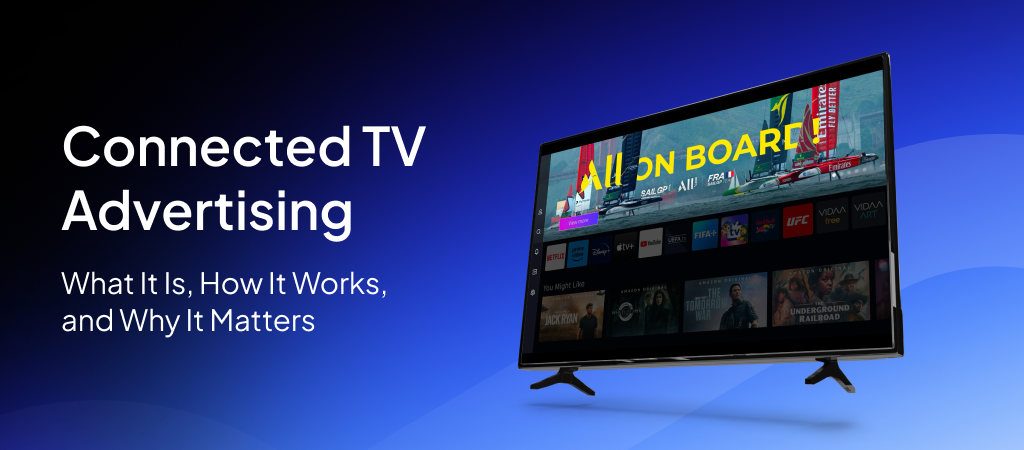
Connected TV (CTV) advertising has quickly become a core pillar of modern media strategies. Yet despite its popularity, definitions, inventory types, and measurement standards still vary widely. That ambiguity creates friction for media buyers trying to evaluate performance, allocate budgets, and justify investment. So let’s clear it up.
What Is Connected TV Advertising?
Connected TV refers to any television that connects to the internet to stream digital content. This includes:
- Smart TVs with built-in streaming apps
- External streaming devices such as Roku, Amazon Fire TV, and Apple TV
- Gaming consoles used to access streaming platforms
Connected TV advertising is the delivery of digital video ads within these streaming environments.
The key difference from traditional linear TV?
CTV ads are served digitally, enabling advertisers to apply targeting, measurement, and optimization capabilities typically associated with digital media — while still reaching audiences on the largest screen in the home.
However, not all CTV inventory is equal. Premium broadcaster apps and curated streaming environments typically deliver stronger attention, brand safety, and measurable outcomes compared to long-tail inventory. As the channel matures, inventory quality is becoming just as important as targeting strategy.
Understanding CTV Inventory Types
CTV encompasses multiple streaming environments, each with different viewer behaviors and advertiser value.
- AVOD (ad-supported video on demand): Subscription platforms offering ad-supported tiers (e.g., Netflix, Disney+, HBO Max)
- FAST (free ad-supported streaming TV): Free, linear-style streaming channels (e.g., Pluto TV, Tubi)
- BVOD (broadcaster video on demand): Streaming apps from traditional broadcasters
- Home screen placements: Ads appearing within the TV interface before content selection
With 61% of households subscribed to multiple streaming services (IAB Compass), your audience is spread across all of these environments.
How Connected TV Advertising Works
Why Completion Rates Matter in Connected TV Advertising
Completion rate is one of the clearest signals of engagement in connected TV.
Industry benchmarks show CTV ads achieve 95%+ completion rates compared to 20-40% on YouTube and under 30% on social video. When you’re paying on a CPM basis, that gap makes a real difference. A higher CPM with near-total completion often delivers more real attention than lower-cost impressions that your audience scrolls past after three seconds.
The reason is simple: CTV ads run full-screen, sound-on, in a lean-back viewing environment. There’s no skip button, no competing content in a sidebar, no notifications pulling attention away. Viewers watch entire ads, the way they did with traditional TV.
Connected TV Advertising Targeting Capabilities
One of the biggest advantages of connected TV is the ability to combine TV-scale reach with digital-style targeting.
Today, 64% of marketers use first-party data for CTV targeting, while 60% apply behavioral or intent-based signals. Common approaches include:
- Demographic and geographic targeting at the household level
- Behavioral segments based on purchase or browsing history
- Contextual alignment with relevant programming,
- Sequential and retargeting strategies across devices
That said, 50% of marketers cite audience targeting inefficiencies as their top CTV challenge. The capability exists, but execution remains uneven.
This is where unified, omnichannel audience strategies are becoming essential.
At Teads, audiences are designed for activation across the entire media ecosystem, not just one channel. Rather than building separate segments for CTV, mobile, and digital, brands can activate one audience, everywhere, ensuring consistency, scale, and efficiency across touchpoints.
Through a global taxonomy of more than 300 omnichannel audience segments, advertisers can reach high-value consumers across verticals such as Automotive, Fashion, Sports, Entertainment, and Travel. These segments are matched and modeled using proprietary data signals that reveal how audiences interact with media across environments.
Common and Emerging CTV Ad Formats
Beyond standard pre-roll and mid-roll video spots, CTV now supports interactive formats where viewers engage directly using their remote or by scanning QR codes. The appetite for interactivity varies sharply by age, illustrated by our 2025 CTV Pulse report:
- 18-24 year olds: 24% will scan a QR code, 15% will add products to a cart directly from an ad
- 25-34 year olds: 14% will add to cart, 12% will scan a QR code
- 55+: Single digits across all interactive features
For advertisers targeting younger audiences, this opens up shoppable opportunities that traditional TV could never deliver.
Why Brands Are Shifting Budget to CTV
The Audience Has Already Moved
Ad-supported streaming is now mainstream. EMARKETER reports that 71% of net new streaming subscriptions over the past nine quarters have been ad-supported. The ad-free holdouts are becoming the minority.
For advertisers, this means the audiences that seemed unreachable on linear TV are now available again, but in a different environment with different rules.
Who’s Investing in CTV (and Why)
Half of large companies (250+ employees) now always include CTV in their marketing strategy, compared to just 6-7% of small businesses. That gap reflects both budget constraints and measurement confidence.
The marketers who have committed cite a few consistent reasons: reaching younger audiences who don’t watch linear TV, applying digital-style targeting to TV-scale inventory, and accessing premium content environments.
What’s Holding Back Larger CTV Budgets
CTV measurement is still catching up, with 53% of marketing decision-makers saying they would increase CTV spend with better ROI measurement. Another 45% want improved attention metrics, and 44% want cross-screen effectiveness tracking.
Attention-based metrics are starting to fill some of these gaps. Campaigns optimized for attention deliver nearly three times the impact of those optimized for viewability alone, according to Teads benchmark data.
Your Viewers Are on Two Screens at Once
Most CTV viewers aren’t just watching the TV. Global Web Index data shows 69% use their phone simultaneously: messaging friends (47%), scrolling social media (41%), or reading emails (48%).
That changes the calculus for media planners. A CTV ad viewed alongside phone activity behaves differently than a linear TV spot from 2005. Viewers might see your ad on the big screen and immediately search for your brand on their phone. Or they might ignore the TV entirely while they scroll.
The campaigns that perform best treat CTV as part of a connected system, not a standalone channel. When the same viewer sees your ad on CTV and then encounters your brand on mobile, those touchpoints compound.
Learn more about the trends shaping this transformation in CTV Advertising in 2026: Trends, Challenges, and Opportunities.
Want to learn how Teads connects brands with audiences across CTV, mobile, and digital?
Get in touch to explore our omnichannel solutions.