

Video has never had more money behind it. Our MMA 2025 State of Video & CTV study found that 94% of senior marketers are maintaining or increasing their video budgets this year, with nearly two-thirds planning significant increases. That level of commitment tells you something about how central the channel has become.
But spending confidence and planning confidence are two different things. Most video strategies still follow a playbook designed for a simpler landscape, where you bought reach on linear, layered in some digital, and hoped the attribution worked itself out. Connected TV (CTV) advertising has changed what’s possible, but in 2026, the real risk isn’t underinvesting in video. It’s investing heavily without updating the way you plan, measure, and produce creative around it.
Video’s Dual Mandate and What It Means for Connected TV Advertising
For years, video sat neatly on the brand awareness side of the media plan while search and social handled performance. That division made sense when the measurement tools didn’t exist to connect a TV impression to a website visit or a purchase.
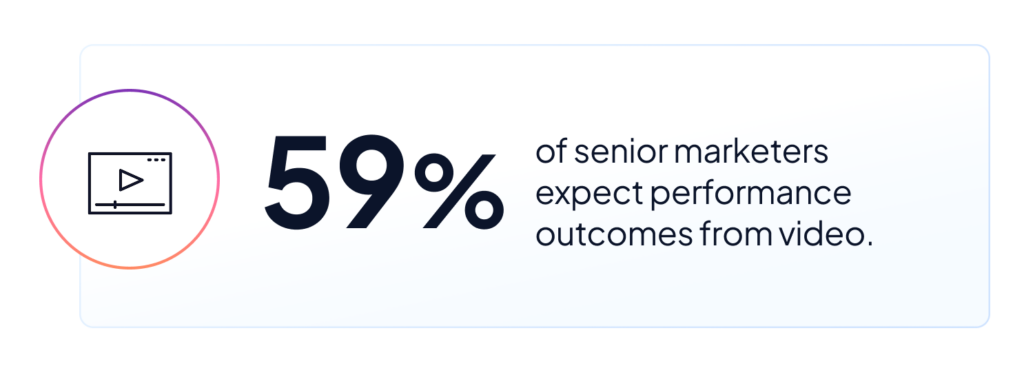
It doesn’t hold up anymore. Our State of Video & CTV research shows 74% of senior marketers still rely on video for brand storytelling, but 59% now expect it to deliver performance outcomes too. Sales and conversions rank as a top video KPI for 41% of marketers, sitting right alongside viewability (45%) and brand awareness (38%). Video is being asked to do both jobs at once, and the teams getting the most from their budgets are the ones planning for that reality rather than defaulting to awareness-only campaigns.
Connected TV advertising is where this dual mandate comes into sharpest focus. CTV combines the storytelling power of television with the targeting and measurability of digital, which is why 82% of senior marketers now run CTV campaigns. But adoption is running well ahead of sophistication. Our research found that only 22% of marketers rate their omnichannel video capabilities as advanced, and while CTV targeting has become more precise, another 40% of marketers describe themselves as still developing. The opportunity isn’t about adding CTV to the plan. It’s about connecting it to everything else.
Why CTV Measurement Is the Biggest Decision Buyers Face This Year
If you ask senior marketers what’s holding their video strategy back, measurement comes up before anything else. Our State of Video & CTV study found that 52% lack unified measurement across video platforms and 55% struggle with budget allocation across video channels. Without consistent metrics across screens, every allocation decision involves some guesswork.
Attention Is Becoming a Planning Currency
The most important shift here is the move toward attention-based metrics. 40% of marketers now treat attention as a core KPI, and 47% are testing alternative measurement currencies from providers like VideoAmp and Comscore.
The reason this shift matters goes beyond having a new number to report on. Viewability tells you an ad had the chance to be seen. Attention tells you whether someone engaged with it. Campaigns optimized for attention deliver nearly three times the impact of those optimized for viewability alone, which makes it a much stronger signal for connecting upper-funnel exposure to business outcomes. For buyers who’ve been frustrated by the gap between video spend and provable results, attention metrics offer a way forward that viewability never could.
Cross-Screen Measurement Is Catching Up
The other development worth watching is cross-screen attribution. Global Web Index data shows 69% of CTV viewers use a second screen while watching, with 31% searching for products they’ve seen on TV. That behaviour means a connected TV advertising impression can be the starting point of a journey that continues on mobile, desktop, or in-store, and the measurement infrastructure to track those connections is improving fast.
Connecting CTV exposure to downstream performance is what turns connected TV advertising from an awareness line item into a full-funnel contributor. Buyers who invest in cross-screen measurement now will be better positioned as these capabilities scale through 2026 and beyond.
How Creative and AI Are Reshaping the CTV Advertising Workflow
Budget and measurement tend to dominate video strategy conversations, but creative is evolving just as fast and getting far less attention.
47% of marketers cite creative adaptation across formats as a top challenge, which makes sense when you consider what a single video campaign looks like in 2026. The same core idea might need to work as a 30-second CTV instream spot, a 6-second mobile pre-roll, a HomeScreen placement, and a shoppable social unit. These CTV ads each demand different pacing, framing, and calls to action.
Generative AI is where most teams are finding practical relief. 60% of marketers now use AI for content creation, making it the most widely adopted AI application in video. What AI does well here is accelerate versioning and adaptation, helping teams produce format-specific creative from a core asset without rebuilding from scratch every time. AI isn’t replacing the creative director, it’s liberating them from the production bottleneck. By automating creative variations, buyers can focus on what has the most impact: the big idea and the cross-screen strategy.The broader shift toward in-housing and hybrid creative models reinforces this trend. More brands want direct control over how their video assets get adapted across formats, and AI tools make that feasible at a scale that would have required a much larger production team even two years ago.
Building a Connected TV Advertising Strategy That Reflects How Video Works Now
The thread running through all of these shifts is that video buying in 2026 rewards precision over volume. Bigger budgets won’t solve measurement fragmentation, creative complexity, or the challenge of connecting CTV to the rest of your media plan. What helps is having a clear view of how each format, channel, and metric ties back to your goals.
Treat connected TV advertising as a cross-funnel channel rather than a single-purpose awareness buy. Prioritise attention-based measurement before it becomes the default expectation from clients and leadership. Build creative workflows that can flex across formats without losing coherence. And connect your CTV strategy to your broader video and digital plan so that impressions on the big screen feed into what happens on every other screen.
The brands and agencies making the sharpest moves this year aren’t necessarily the ones spending the most on video. They’re the ones who’ve put the planning, measurement, and creative infrastructure in place to make every pound and dollar work harder.
Ready to build a video strategy that works across every screen?
Get in touch to explore how our connected TV advertising solutions fit into your media plan.