


Most media buyers still think of connected TV (CTV) advertising as a brand channel rather than a performance channel. You run a premium spot, it looks great on a big screen, and the video completion rate tells you people watched it. That was the pitch for years, and it worked well enough to get CTV onto media plans. But it left a hard question unanswered: did the CTV ad drive any business impact?
That question is now answerable. Connected TV advertising campaigns are being measured against site visits, qualified leads, registrations, and incremental sales, with deterministic attribution connecting what someone saw on their TV to what they did on their phone or laptop afterward. The technology has caught up with the expectation, and the results prove the value of CTV ads on performance KPIs.
The Best Connected TV Advertising Strategies Combine Brand and Performance
There’s a tendency in media planning to treat brand building and performance as separate activities with separate budgets and separate KPIs. CTV has historically sat firmly on the brand side. That split is starting to look outdated.
Research shows that 70% of over-performing marketers believe a combination of branding and performance tactics is what drives short-term actions among their target audience. CTV is particularly well suited for this because it combines the emotional impact of full-screen, sound-on video with the measurability of digital. A viewer sees your brand story on the biggest screen in the house, then takes action on their phone while it’s still fresh. The brand impression and the performance outcome happen in sequence – and the measurement infrastructure now connects the two.
Our MMA 2025 State of Video & CTV study found that 41% of senior marketers now rank sales and conversions as a top KPI for video advertising, sitting alongside viewability (45%) and brand awareness (38%). The campaigns seeing the strongest results are the ones optimizing toward mid-funnel outcomes like qualified site visits, time on site, and add-to-carts rather than treating CTV as a reach play with completion rate as the headline metric. The metric you choose to optimize toward shapes the outcome more than most people realize.
How CTV Measurement Connects a TV Impression to a Website Visit
The reason CTV was hard to measure for so long is that the action never happens on the same device as the ad. Nobody clicks a TV. The viewer watches a 30-second spot, then picks up their phone and searches the brand, visits the site, or adds something to a cart. Connecting those two moments across devices is the technical challenge that had to be solved before CTV could be taken seriously as a performance channel.
Teads’ CTV Performance solution solves it through a four-step process. In-stream CTV ads are delivered to identified households. Visits are then measured across all devices within that household, including those outside the home wifi. Those on-site visits are attributed back to the specific CTV exposure. And the system optimizes delivery and reports on attributed CTV traffic, all within an attribution window of up to 30 days.
The Teads’ Universal Pixel sits on the advertiser’s site and records the activity. Our household graph handles the cross-device matching, and impressions are only served when that measurement is possible. In practice, that means CTV Performance campaigns reach a more targeted pool of households (roughly 60% of addressable opportunities in the US and 25% in EMEA) but with far greater confidence in what those impressions led to.
A machine learning algorithm ties it all together. It draws on campaign data points including country, device, channel, ad creative, advertiser vertical, and past site visit patterns to predict which viewers are most likely to take action and shifts delivery toward them. The performance gains from this optimization are significant: campaigns using the algorithm have seen a 79% lower cost per quality visit, 3.25x more visits, and a 341% higher landing page rate compared to non-optimized CTV campaigns.
Real Campaign Results That Show CTV Advertising Performance
The case studies running through our platform make the performance case concrete.
Men’s Wearhouse ran a CTV Performance campaign with interactive video and QR codes during key retail moments. It generated over 41,000 site visits and 8,000 add-to-carts, with a 0.54% click-through rate (170% above benchmark) and an average on-site session of 2 minutes and 17 seconds. Beyond digital, the campaign drove more than 50,000 incremental store visits, a 14.4% lift.
Finanzguru, a personal finance app, used CTV Performance to drive registrations among adults aged 25 to 40. Instead of sending viewers to the app store, the campaign guided them to a dedicated landing page. It delivered 410+ registrations, a 17% lower bounce rate versus the site benchmark, 47% more time on site, and a 27% higher customer lifetime value compared to other acquisition channels.
IONIQ Skincare paired CTV HomeScreen exposure with InRead retargeting to test whether upper-funnel brand exposure improved lower-funnel efficiency. Audiences previously reached on CTV showed a 38.5% higher CTR and 16.3% lower CPC in retargeting. The campaign delivered a 6% incremental sales lift and a higher average order value.
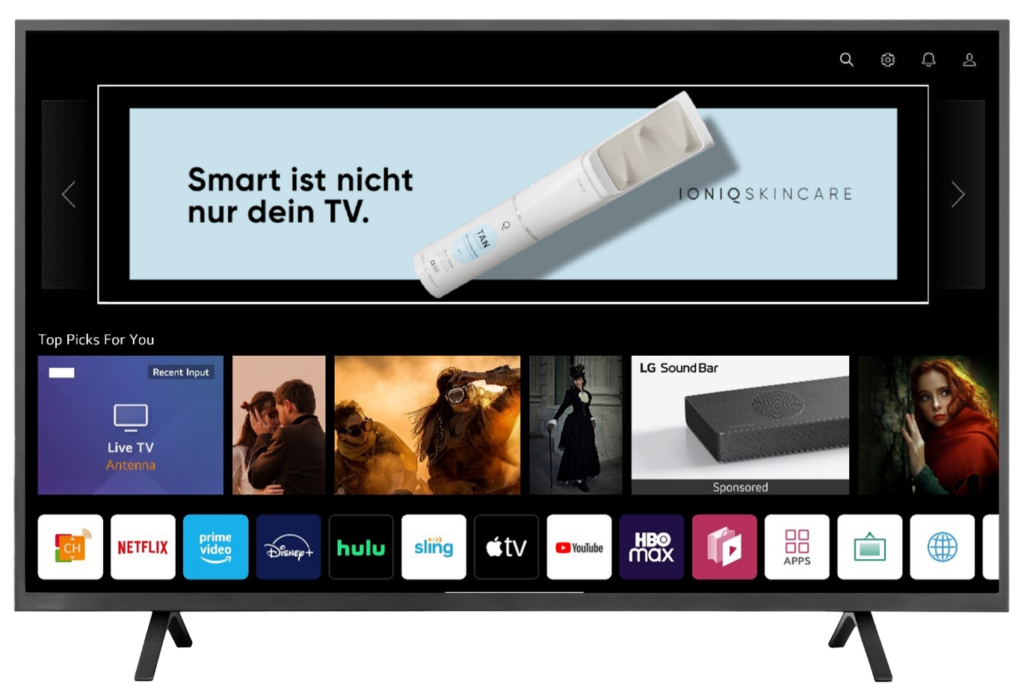
These CTV campaigns span retail, finance, and skincare. The common thread is measurable mid-funnel and lower-funnel outcomes tied directly to CTV exposure.
Getting the Creative and Setup Right for CTV Performance Campaigns
The CTV ads that drive the strongest performance outcomes tend to follow a few principles.
Creative should prioritize top-of-mind branding over product-level promotion. That might sound counterintuitive for a performance campaign, but CTV is a lean-back environment where brand recall and emotional resonance do the heavy lifting. The conversion happens later, on a different screen. What the CTV ad needs to do is make the brand memorable enough that the viewer follows through.
The primary CTV ad formats for performance campaigns are CTV InStream (15 or 30 seconds) and InStream + Skin, where a branded overlay surrounds the video to maximize exposure. Teads Studio works with advertisers to build these, including branded skins and QR codes that give viewers a clear path to the site.
Landing page strategy matters too. For softer mid-funnel goals like awareness and consideration, driving to the brand homepage tends to work well. For deeper funnel objectives, sending visitors to specific product pages converts more efficiently. And the Teads pixel needs to be installed before launch so that CTV measurement, attribution, and optimization all function from day one.
Connected TV Advertising Has Earned Its Place in the Performance Budget
CTV built its reputation on reach, completion rates, and brand storytelling. Those strengths remain. But the channel has now developed the attribution, CTV targeting, and measurement infrastructure to compete for performance budgets alongside search, social, and display.
For media buyers evaluating where performance budgets should go, CTV advertising has reached a point where the channel can be held to the same accountability standards as any other digital medium. The brands already running CTV Performance are seeing that reflected in their site analytics, their registration numbers, and their sales data.
Want to see how CTV Performance could work for your brand? Get in touch with our team.