


Taiwan is one of Asia’s most advanced Connected TV (CTV) markets, defined by high Smart TV penetration, strong broadband infrastructure, and a digitally mature audience that increasingly consumes premium video content on the largest screen in the home.
As viewing behavior continues to evolve, one insight has become increasingly clear: the CTV Homescreen is no longer just a navigation layer, it is the new discovery engine of the living room.
It is where attention is intentional, decisions are made, and brands have the opportunity to influence viewers before content begins.
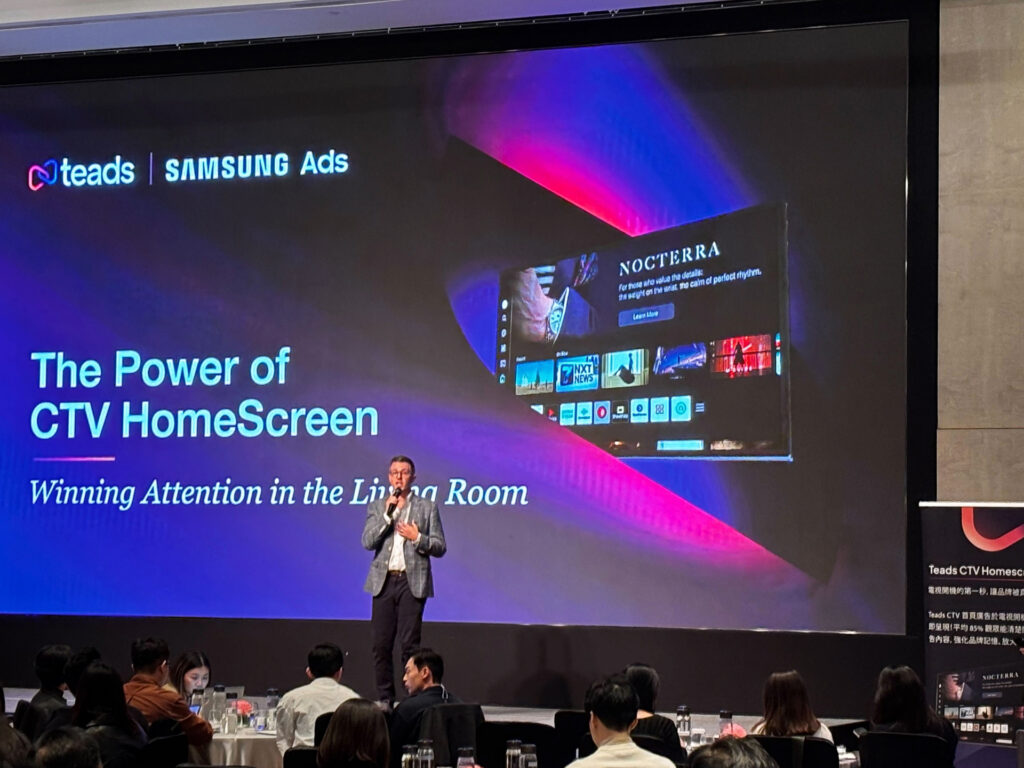
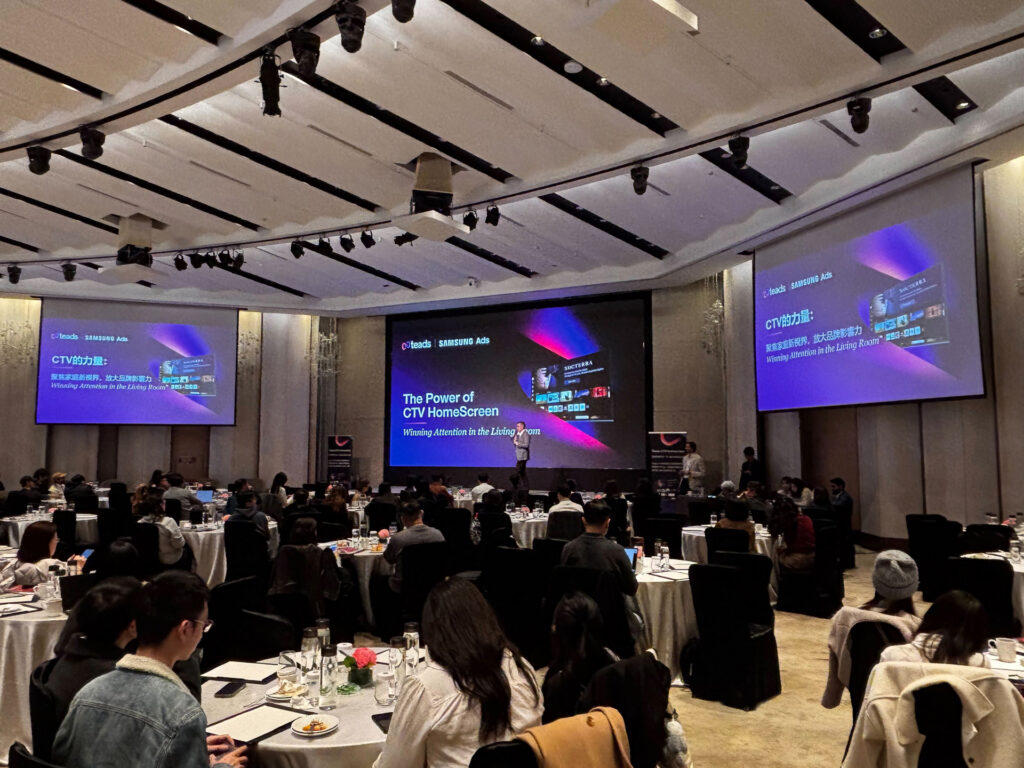
Against this backdrop, Teads, in partnership with Samsung Ads, hosted The Power of the CTV Homescreen panel discussion in Taiwan, bringing together senior leaders from Omnicom Media Group, iProspect, and WPP Media to unpack how brands should rethink CTV strategy in an increasingly fragmented yet opportunity-rich ecosystem.
Reframing CTV in Taiwan: From “Will It Work?” to “How Should We Define It?”
Opening the discussion, host Nicky Hsieh, Director at DMA, set the tone with a clear observation:
the question for Taiwan’s CTV market is no longer whether CTV matters, but how it should be defined, measured, and activated.
While Smart TV adoption and big-screen viewing continue to grow, the industry still lacks a unified definition of CTV. Fragmentation across devices, platforms, entry points, and ad formats has made it difficult for brands to consolidate viewing behavior, standardize measurement, and confidently scale budgets.
As panelists from Omnicom Media Group, iProspect, and WPP Media highlighted, this lack of standardization often results in:
- Dispersed budgets across too many touchpoints
- Inconsistent KPIs between linear TV and digital
- Growing pressure on agencies to justify investment with clarity and confidence
The challenge is no longer audience reach, but decision confidence.
Mapping the Funnel: Not All CTV Placements Play the Same Role
A key theme throughout the panel was the need to rethink how awareness is built on Connected TV—starting with the Homescreen.
Panelists discussed how at-home viewing behavior in Taiwan has evolved. Where television was once consumed alongside mobile devices and other distractions, today’s viewers are increasingly focused on the TV itself. Greater content choice, improved interfaces, and the comfort of watching at home have made the large screen a more immersive and engaging environment.
The Homescreen sits at the center of this shift. It is the first point of contact when the TV is turned on, appearing at a moment of active decision-making, before any content is selected. This makes it a powerful environment for driving brand awareness, establishing presence, and shaping first impressions.
Unlike in-app video advertising, which reaches viewers after a choice has already been made, the Homescreen influences discovery itself, what viewers notice, where they navigate, and which brands stand out first.
From Teads’ omnichannel perspective, Jovy Lin, Co-Host and representative from Teads, shared international case studies, highlighting how combining CTV Homescreen exposure with mobile In-Read formats has delivered incremental brand lift and stronger recall.
The insight was clear:
Brands don’t lack the desire to invest in branding, they often lack the right environments for brands to show up meaningfully.
Why the Homescreen Is the Most Powerful Entry Point
Among all CTV placements, the Homescreen emerged as the most strategically valuable.
Panelists emphasized that the Homescreen is:
- The first visual impression when a TV is turned on
- A moment of active decision-making, not passive viewing
- Highly visible, uncluttered, and often exclusive
Unlike in-app video ads, which appear once a user has already chosen content, the Homescreen influences choice itself, what to watch, where to go, and which brands are noticed first.
From a storytelling perspective, this makes the Homescreen uniquely powerful for:
- Establishing brand presence
- Anchoring premium perception
- Acting as the first step in cross-screen journeys
Through Teads’ partnership with Samsung Ads, brands in Taiwan can now access this moment at scale, across premium, brand-safe Samsung Smart TV inventory.
Rethinking Creative & Investment for the Big Screen
With production costs decreasing but marketing budgets under pressure, panelists agreed that investment strategy, not volume, is the real differentiator.
Rather than spreading budgets thinly across multiple platforms, brands should:
- Prioritize high-quality, large-screen environments
- Design creative specifically for the Homescreen: clarity, immediacy, and strong brand codes
- Balance high-impact takeovers with always-on rotational placements
Teads highlighted how its creative solutions, including 3D formats and big-screen optimized design, help brands elevate storytelling while maintaining efficiency within an omnichannel framework.
Making Measurement Work for Brands
Measurement remains one of the biggest barriers to scaling CTV investment.
As CTV sits between linear TV and digital, brands increasingly expect:
- The reach and impact of television
- The accountability and transparency of digital
Panelists agreed that success frameworks must evolve beyond traditional impressions to include:
- Brand lift and attention metrics
- Incremental reach across screens
- Cross-platform attribution
From Teads’ perspective, product development, across mobile and CTV, has consistently been built to meet global brand standards, ensuring that Homescreen performance can be integrated into broader brand and performance measurement frameworks.
The Future of Taiwan’s CTV Ecosystem
Looking ahead, panelists were aligned on several trends shaping the next phase of growth:
- Continued decline of traditional cable TV
- Younger audiences spending more time watching premium content on Smart TVs
- Homescreens becoming the primary gateway into content ecosystems
As Jovy Lin noted, while Homescreen may not fully replace cable TV, its influence will continue to rise—especially as TV prices become more accessible, picture quality improves, and time spent on the Homescreen increases.
In closing, Nicky Hsieh summarized the state of the market powerfully: there is no single platform that defines “success” in Taiwan’s living room today. Winning will require cross-platform integration, Homescreen-first thinking, and deeper collaboration across brands, agencies, and platform partners.
Key Takeaways
- The CTV Homescreen is the new front page of the living room, shaping discovery before content begins
- Fragmentation remains a challenge, but also creates opportunity for strategic partners to simplify execution
- Not all CTV placements serve the same role; Homescreen plays a critical upper-funnel and discovery function
- Premium environments and creative quality matter more than sheer scale
- Measurement must balance TV-level impact with digital-level accountability
- Homescreen-led strategies will play a growing role in Taiwan’s future media plans
Teads Perspective
Through partnerships with Samsung Ads, LG, and Google TV, Teads enables brands to unlock the full power of the CTV Homescreen, delivering scale, quality, consistency, and measurability through a single strategic activation partner. This is not just an extension of CTV advertising. It is a shift toward homescreen-first planning, and a critical step in helping brands truly win the front page of the living room in Taiwan.