

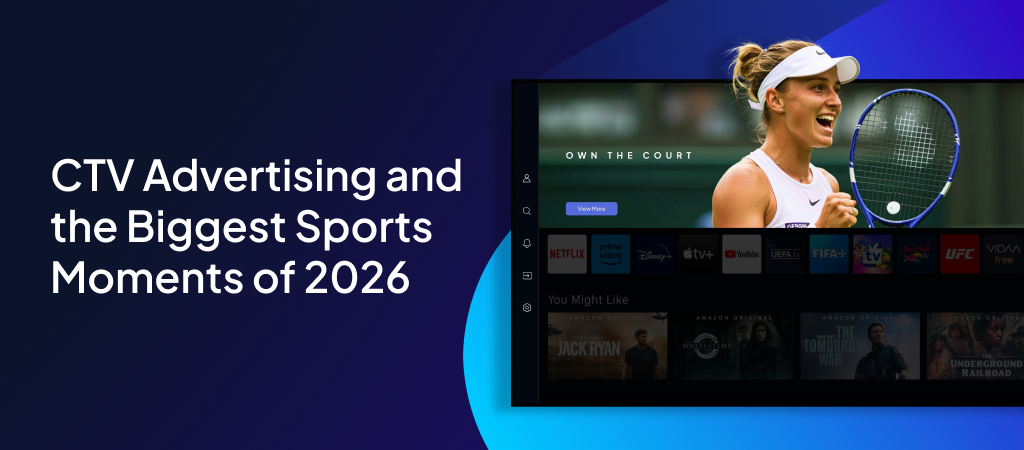
The 2026 sports calendar has already delivered some standout moments, from the Winter Olympics in Milano Cortina to the Super Bowl and the World Baseball Classic. And the biggest events are still ahead: the FIFA World Cup across the US, Canada, and Mexico, Wimbledon, the Commonwealth Games in Glasgow, and a full slate of Grand Slam tennis, Formula 1 races, and the Asian Games through the fall.
For brands, these events represent some of the largest and most engaged audiences available anywhere in media. And connected TV (CTV) advertising in particular benefits from something increasingly rare in a fragmented landscape: concentrated, high-attention, big-screen moments where millions of viewers are watching at the same time.
But in 2026, those moments don’t exist in isolation. Sports audiences move fluidly across screens – watching on TV, engaging on mobile, and continuing their journey across the open internet. The opportunity for brands is no longer just to show up during the moment, but to connect that moment into a broader omnichannel experience.
The question for media buyers is how to make the most of them.
In her recent IAB NewFronts session, our CMO Dani Cushion expands on these shifts in viewer behavior and what they mean for brands looking to connect with sports audiences across screens.
Why Sports Audiences Matter for CTV Advertising
Live sports has always been one of television’s strongest draws, and that holds true in streaming. Research shows that 73% of viewers prefer watching sports on a big screen, with smart TVs and streaming devices now the most popular way to tune in.
As live rights continue shifting to platforms like Amazon, Peacock, and ESPN+, the CTV sports audience keeps growing. According to Ampere Analysis, streaming services are projected to spend $14.2 billion on live sports rights in 2026, more than double the $6.5 billion spent in 2022.
What makes this audience valuable for CTV advertising goes beyond size. Sports viewers are highly attentive, emotionally engaged, and watching in real time. CTV ads delivered during live sports have been shown to outperform cable and broadcast equivalents by as much as 66% in terms of performance outcomes, according to industry data from the 2024-2025 NFL season.
The appetite is there on the buy side too. According to a Premion and Advertiser Perceptions study, 78% of CTV advertisers are already running live sports campaigns, with 79% planning to increase their spend over the next 12 months.
The 2026 Sports Calendar and What It Means for CTV Advertising
The density of the 2026 calendar creates a sustained window of opportunity rather than a single tentpole moment. Brands can build connected TV advertising strategies that run across multiple events throughout the year.
The Winter Olympics in February set the tone early. Our 2026 Sports Moments study with Censuswide found that attention around the Olympics builds well before opening night and stays elevated long after the medals are awarded. According to our proprietary Media Barometer, page views related to winter sports surged in the lead-up, with figure skating interest up more than 340%, speed skating up 225%, and alpine skiing up 108%.
The headline event still to come is the FIFA World Cup, which will dominate June and July. Here’s what makes it such a significant opportunity for CTV campaigns:
- 48 teams and 104 matches across 16 host cities in the US, Canada, and Mexico
- The largest World Cup ever, expanded from the previous 32-team format
- Over 5 billion cumulative viewers tuned in to the 2022 edition, with 2026 expected to surpass that
- Weeks of sustained attention, with group stages, knockouts, and the final at MetLife Stadium on July 19
Beyond the World Cup, the rest of 2026 offers consistent planning windows: the Masters in April, Wimbledon in July, the Commonwealth Games in Glasgow in late July, the Asian Games in Nagoya in September, and the Rugby League World Cup in Australia closing out the year. Each event brings its own audience profile and attention peak.
Taken together, these moments create a year-long framework for omnichannel CTV strategies that connect audiences across screens rather than relying on isolated activations.
How CTV Targeting Helps Brands Reach Sports Fans Across Screens
One of the defining characteristics of sports viewership in 2026 is that it doesn’t stay on a single screen. Our Sports Moments study found that second-screening during live sports is now standard behavior. In Italy, the host market for the Winter Olympics, 57.2% of viewers say they regularly use another device during live sports, rising to 77% among Millennials.
Globally, CTV plays a central role in how different generations follow sports:
- Gen Z: 43.8% follow major sports moments via CTV
- Millennials: 57.6%
- Gen X: 61.5%
- Baby Boomers: 30.6%
This generational spread means connected TV advertising during sports events can reach a broad demographic in a single campaign. CTV measurement and cross-screen retargeting then extend that reach into mobile and web afterward.
A viewer watching the World Cup final on their smart TV is likely also on their phone, checking scores, reading commentary, and browsing products. Brands that combine CTV exposure with cross-screen retargeting and interactive CTV ad formats can follow that viewer from the big screen to the second screen while interest and intent are at their highest.
This is where an omnichannel approach becomes critical. Rather than treating CTV as a standalone channel, it becomes the anchor of a broader strategy that connects premium video environments with mobile, web, and contextual touchpoints across the open internet.
Sports Audiences Are More Open to CTV Ads Than You’d Expect
Our Sports Moments study revealed something worth noting for brands outside traditional sports categories. Compared to general sports audiences, fans following the Winter Olympics are more open across several key dimensions:
- More likely to trust brands that aren’t usually associated with sports
- More willing to learn about new products
- More inclined to try something new
That openness stretches well beyond sportswear and food and beverage. The data shows space for entertainment, travel, technology, automotive, beauty, financial services, and retail brands to participate credibly during these moments. The Olympics in particular attract a diverse fan base (40% dedicated fans, 35% casual fans globally) that responds well to contextually relevant CTV ads regardless of category.
Relevance matters here. Nearly 69% of consumers globally say they are more likely to engage with an ad when it aligns with the content they’re viewing. Creative that reflects the tone and energy of a sports moment consistently outperforms generic messaging.
This is where creative, format, and environment play a role. High-impact placements like CTV HomeScreen, combined with contextual alignment and creative adaptation, shift CTV from a passive awareness channel into an active driver of attention and performance. Through Teads Studio advertisers can build CTV creatives that integrate more naturally into the viewing experience rather than interrupt it.
Planning Connected TV Advertising Around Sports in 2026
The 2026 sports calendar offers something rare: sustained, high-attention moments at global scale.
But the way audiences engage with those moments has changed. They don’t just watch – they interact, search, share, and act across multiple screens.
Brands that take an omnichannel approach to connected TV advertising across the full sports calendar can build frequency and reach across multiple high-attention events, reinforcing messaging over time instead of relying on a single flight.
Connected TV advertising is uniquely positioned at the center of that behavior. It anchors attention on the biggest screen, then extends that attention across devices and environments through omnichannel activation.
This is where continuity becomes critical. Teads’ approach is built around connecting these experiences. By combining CTV experiences with premium web placements across selected inventory on the open internet, brands can extend sports moments beyond across screens – connecting exposure, engagement, and outcomes into a unified strategy.
For brands, the opportunity is not just to be present during the moment, but to connect it – to turn every sport, every screen, and every moment into a cohesive, measurable experience.Want to explore how CTV can work for your brand around 2026’s biggest sports moments?
Get in touch with our team.