

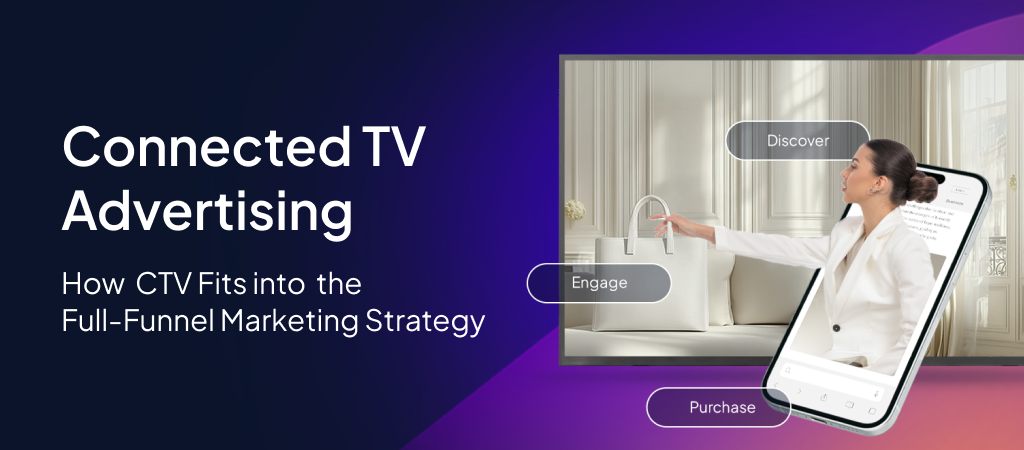
For a long time, connected TV (CTV) advertising lived in a tidy box marked “awareness.” Brands ran cinematic spots on streaming platforms, counted impressions, and hoped something stuck. The funnel below? Handled by other channels.
That thinking made sense when CTV lacked the targeting and measurement to do much else. But the channel has evolved fast. With first-party data, cross-screen attribution, and interactive ad formats now in play, connected TV advertising can support every stage of the customer journey. The brands getting the most from CTV in 2026 treat it as a full-funnel marketing lever, not a single-purpose awareness play.
Why Connected TV Advertising Delivers at the Top of the Funnel
Let’s start with what CTV already does well. The awareness case is strong and getting stronger.
CTV ads run full-screen, sound-on, in a lean-back environment where viewers are actively engaged. Industry benchmarks show completion rates above 95%, compared to 20-40% on YouTube and under 30% on social video. Your message gets watched, not scrolled past.
Our MMA 2025 State of Video & CTV study found that 74% of senior marketers see video as a core channel for brand awareness and storytelling. And the results back that up: omnichannel campaigns that include CTV deliver 55% higher brand awareness compared to Lucid benchmarks, with CTV specifically driving 40% higher upper-funnel performance.
But awareness on its own doesn’t close deals. That’s why the full-funnel conversation around connected TV advertising matters.
Moving Connected TV Advertising Beyond Awareness
CTV at the Consideration Stage
This is where connected TV advertising gets interesting for media planners. Once a viewer has seen your brand on the big screen, what happens next?
Most CTV viewers don’t sit passively. Global Web Index data shows 69% use their phone while watching: 47% messaging, 41% scrolling social media, and 31% actively searching for products on screen. That second-screen behavior is a consideration-stage gift.
The campaigns performing well at this stage use CTV exposure as a trigger for cross-screen retargeting. Someone watches your 30-second spot during a streaming show, then encounters a follow-up ad on mobile that deepens the message. Sequential creative tells a story across touchpoints rather than repeating the same ad everywhere.
Interactive CTV ad formats play a role here too. Our 2025 CTV Pulse report found that:
- 24% of 18-24-year-olds will scan a QR code from a CTV ad
- 15% will add products directly to a cart.
For younger demographics especially, connected TV is shortening the path between seeing and exploring. CTV HomeScreen placements capture viewers at the moment of content discovery, creating high-attention touchpoints before streaming even starts.
CTV Measurement and the Lower-Funnel Connection
Connecting CTV exposure to lower-funnel outcomes has been the channel’s biggest challenge and the area seeing the most progress. Our State of Video & CTV study found that 41% of senior marketers now rank sales and conversions as a top KPI for video, sitting right alongside viewability (45%) and brand awareness (38%).
That shift reflects broader expectations. CTV isn’t being evaluated purely on reach anymore. Brands want to know whether someone who saw a CTV ad went on to visit the website, download the app, or purchase a product.
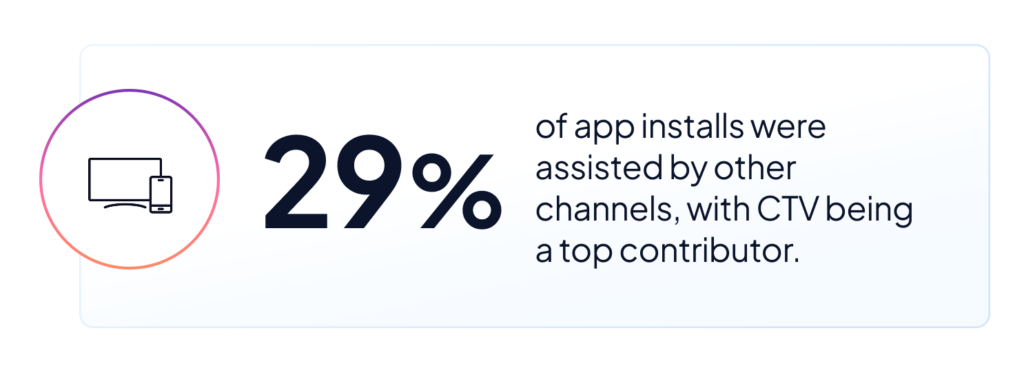
Cross-device attribution and cross-screen measurement now makes this possible. When a CTV impression is linked to a household ID, advertisers can track what happens next on other devices. Research from Adjust found that 29% of app installs across a 2.7 billion install sample were assisted by impressions on other channels, with CTV proving to be one of the strongest assist channels. That’s full-funnel contribution, not just awareness.
Building a Connected TV Advertising Strategy Across the Funnel
Match Your KPIs to Each Stage
One of the most common mistakes in CTV planning is applying awareness metrics to every campaign. A full-funnel approach needs different success measures:
- Awareness: Reach, frequency, video completion rate, and brand lift
- Consideration: Engagement metrics, site visits after exposure, and attention scores
- Conversion: Cost per acquisition, return on ad spend, and incremental sales lift
The State of Video & CTV study found that campaigns optimized for attention deliver nearly three times the impact of those optimized for viewability alone. The metrics you optimize toward matter as much as the creative itself.
Connect CTV to Your Cross-Screen Strategy
CTV works best when it’s integrated into the broader media plan. Our research shows 64% of marketers use first-party data for CTV targeting and 60% use behavioral targeting, so the same audience segments driving your display, social, and search campaigns can inform your CTV strategy too.
The challenge is that 71% of marketers still develop separate audience strategies for each channel, even though viewers move fluidly between screens throughout the day. The brands seeing the strongest results are building cross-screen strategies that connect CTV exposure to mobile engagement, using consistent audience segments and sequential messaging across touchpoints.
Connected TV Advertising Has Outgrown Its Original Job
CTV started as an awareness channel because the technology didn’t support much else. That’s no longer the case. With 53% of marketing decision-makers saying they’d increase CTV spend if measurement improved (according to our 2025 CTV Pulse report), and 58% planning to raise their CTV budgets this year (per Mediaocean’s 2025 H2 Market Report), the industry has moved past awareness-only thinking.
The opportunity for media buyers and planners is to stop treating CTV as an isolated line item and start integrating it across the funnel. Build brand recognition at scale, retarget engaged viewers on their second screens, and track how impressions contribute to conversions. The measurement infrastructure is catching up. The audience is already there.
Want to see how connected TV advertising works across every stage of the funnel?
Get in touch to explore how our connected TV and omnichannel advertising solutions support full-funnel campaigns.