


Sometime in mid-2025, connected TV crossed a symbolic threshold: it now accounts for a larger share of TV viewership than cable and broadcast combined. Ad-supported tiers have become the norm rather than the exception, with EMARKETER forecasting connected TV advertising spend to reach a whopping $37.95 billion this year, a 15% jump that puts it on track to overtake traditional TV by 2028.
But scale brings scrutiny. What we believe will define 2026 is a pivot from growth to accountability. After years of audience expansion and rapid budget increases, brands are now being forced to ask harder questions: Can we prove CTV delivers? How does it connect to what happens on mobile, desktop, and in-store? And what does an effective cross-screen strategy look like when viewers move fluidly between devices throughout the day?
The answers to these board-level concerns will drive real changes in how media gets planned, bought, and measured, and thankfully, those answers are beginning to emerge. Gone are the days of treating connected TV as a separate line item or experimental budget. In 2026, CTV advertising sits squarely at the center of a converged media strategy, where TV screens, mobile devices, and digital channels work together rather than competing for attention.
Three Trends Defining CTV Advertising in 2026
1) AI turns CTV from a channel into a system
CTV has the scale. What it lacks is simplicity. Every platform produces different signals and uses different measurement frameworks, which makes running cohesive campaigns harder than it should be. The advertisers pulling ahead in 2026 are the ones who can optimize intelligently across this fragmented ecosystem.
AI-powered optimization is emerging as the layer that connects these silos. Rather than treating each platform as a separate buy, AI can identify performance patterns across placements, support frequency management, and shift delivery in-flight based on signals of attention and post-exposure behavior.
As CTV budgets grow and accountability demands increase, this kind of intelligent optimization is shifting from a nice-to-have to a necessity.
2) CTV gets serious about performance
Connected TV advertising continues to grow at a 12% compound annual growth rate, comfortably ahead of digital advertising overall. Yet combined TV and CTV spending grows at just 1.1% through 2029, according to EMARKETER forecasts. The total pie stays roughly the same — while CTV claims more of it each year. Linear, in effect, is funding its own replacement.
For media buyers, the pressure is on to prove that every dollar shifted into CTV delivers measurable returns across the full funnel, especially as CTV becomes more addressable and outcomes-driven.
3) Audiences watch one screen while holding another
Global Web Index data from our 2025 UK CTV Pulse report shows that 69% of UK viewers use their phone as a second screen while watching CTV. That’s nearly 7 out of 10 people splitting their attention across devices — messaging friends, scrolling feeds, and searching for products as they see them.
Brands know that someone watching their ad might immediately search for more product information or check reviews while the commercial is still playing. So they’re designing experiences that pick up exactly where the TV ad left off — creating a natural flow between screens and turning attention into action in real time.
The CTV Measurement Hurdle
If there’s one thing holding connected TV advertising back from capturing even more budget, it’s the measurement gap. The channel has matured. Accountability? Not quite.
Unsurprisingly, 53% of marketing decision-makers say they’d increase CTV investment if they had better ROI measurement, according to our 2025 State of Video & CTV study. Another 45% want improved attention metrics. And 44% are looking for cross-screen effectiveness tracking that connects exposure to outcomes. These are fair but tricky asks that represent the difference between CTV as a promising, upcoming channel and CTV as a proven performance driver.
The challenge is structural. Traditional TV metrics weren’t built for app-based viewing, shared screens, and fragmented platforms. Marketers are cobbling together solutions (marketing mix models here, incrementality tests there, brand lift studies somewhere else), but few have unified these approaches into a coherent system. In fact, 52% of senior marketers cite the lack of unified measurement across platforms as a top barrier to omnichannel success.
The good news? The industry is responding quickly. Attention-based metrics are emerging as a bridge between brand and performance measurement, with 55% of marketers believing attention will become standard for both CTV measurement and buying. And standardization efforts like IAB Tech Lab’s Open Measurement SDK and Conversion API frameworks are finally bringing more consistency to what has long been a fragmented landscape.
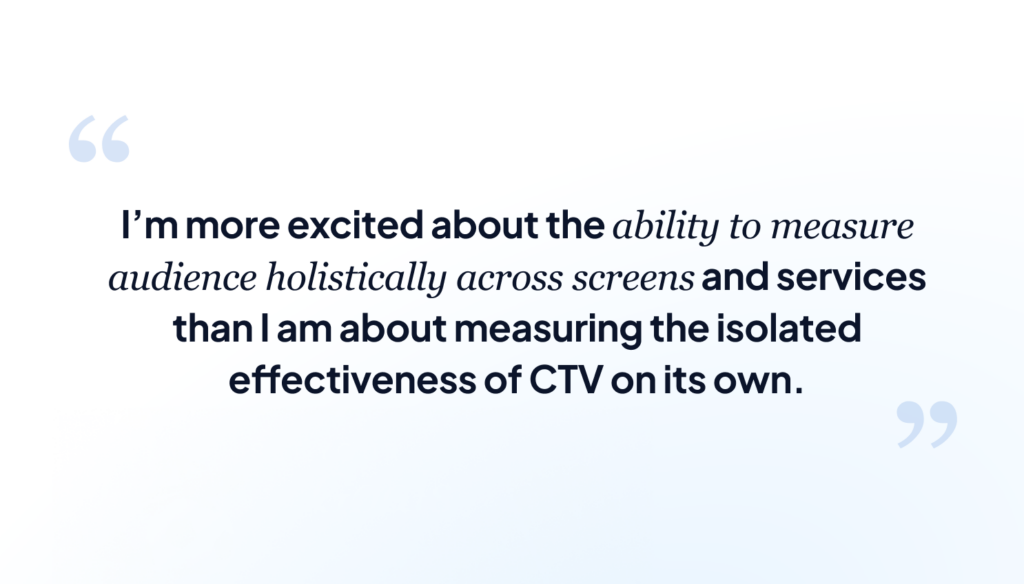
To summarize the mindset shift happening across the industry, here’s how Jon Waite, EVP and Global Head of Planning at Havas Media Network, puts it:
Where Brands are Finding an Edge with CTV Ads
For media buyers and brand managers navigating connected TV advertising in 2026, several opportunities stand out.
Interactive CTV ads are gaining real traction
Younger audiences in particular are willing to engage with CTV ad formats in ways that weren’t possible with traditional TV. Our CTV Pulse research found that 15% of 18-24-year-olds and 14% of 25-34-year-olds are willing to add products to a shopping basket using interactive features in CTV ads. Innovid’s 2025 CTV Insights report shows QR code usage has grown more than 3x year-over-year, and industry data suggests shoppable CTV ads are converting at significantly higher rates than standard video. For brands targeting younger demographics, this is where creative experimentation pays off.
Sports and live events create big-screen moments worth planning around
The overwhelming majority (73%) of UK viewers prefer watching sports on a big screen, and 2026 brings a packed calendar of major events. As live sports increasingly moves to streaming platforms like Amazon, Netflix, and Peacock, advertisers have new lucrative opportunities to reach highly engaged audiences in premium environments. The key, as we’ve discussed, is connecting that impression to what happens on their second screen during or after the event.
Cross-screen planning is becoming essential
At the time of writing, roughly 71% of marketers are still developing separate audience strategies for each channel, but the viewers themselves are moving fluidly between screens. The brands seeing the best results are those connecting CTV exposure to mobile engagement, using first-party data (now used by 64% of marketers) and behavioural CTV targeting (60%) to maintain relevance across touchpoints. When someone sees an ad on their TV and later encounters the same brand on their phone, the combined effect is greater than either impression alone.
HomeScreen placements reach audiences you’d otherwise miss
Not everyone watches ad-supported content, but everyone navigates their TV’s home screen. HomeScreen advertising offers a way to reach viewers who might be invisible to traditional CTV campaigns, delivering high-visibility placements in a premium, brand-safe environment before they even select what to watch.
What Connected TV Advertising Means for 2026 Planning
CTV advertising has graduated from “promising channel” to “prove it or lose it.” The questions marketers ask have shifted from “Should we be in CTV?” to something harder: How do we make it work across screens, prove it delivers, and connect it to real business outcomes?
For media buyers and planners, that means thinking beyond isolated CTV activations. It means building integrated video strategies that follow audiences wherever they go, demanding better measurement, testing new currencies, and pushing for cross-screen attribution that connects the dots between exposure and action. The real challenge is figuring out how to tell cohesive, relevant, and authentic stories when viewers bounce between seven different devices throughout their day.
Viewing behavior has already changed. Budgets are following. The opportunity now is to build the connections that turn CTV impressions into measurable outcomes across the full customer journey. And for brands willing to think beyond a single screen, 2026 is shaping up to be a very good year.
Want to go deeper? Discover the fundamentals in Connected TV Advertising: What It Is, How It Works, and Why It Matters.
Want to learn how Teads connects brands with audiences across CTV, mobile, and digital?
Get in touch to explore our omnichannel solutions.