

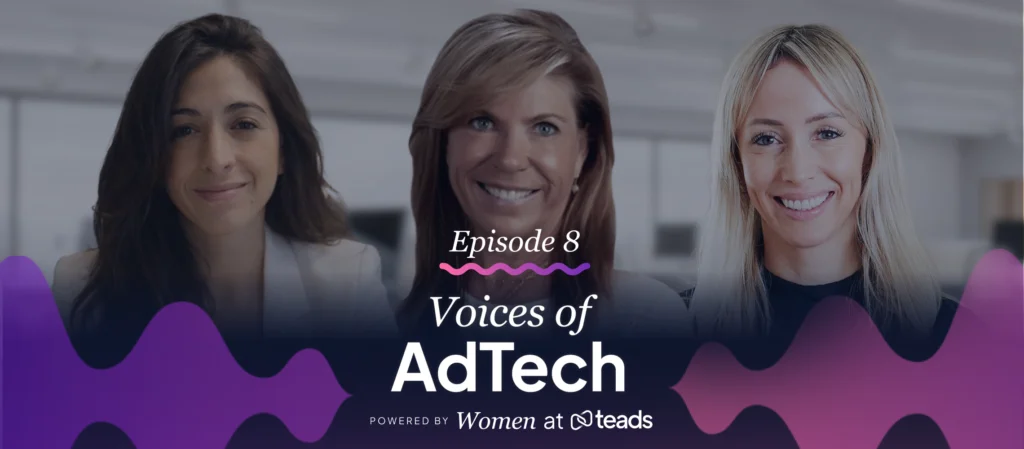
What does it take to lead a global Commercial organization while two companies are coming together and the adtech market continues to reinvent itself?
In the latest episode of Voices of AdTech, a platform brought to you by Women@Teads to amplify diverse leadership across our industry, Amy China Wire and I, Ale Herrera, explored that question with Mollie Spillman, Chief Commercial Officer at Teads. Mollie has worked in adtech since before the industry had a name, with a career spanning Yahoo, Millennial Media, Criteo, Oracle and now Teads. She has seen new technologies emerge, markets reset and organizations grow through periods of real uncertainty.
What made the conversation particularly interesting was Mollie’s openness. She is optimistic about the opportunities ahead, but she does not separate that optimism from the work required to make them real.
Choosing adtech, twice!
One of Mollie’s defining career moments came when the internet bubble burst in 2000. After losing her job at a startup, she returned to traditional media and began questioning whether she had truly believed in digital advertising or had simply been caught up in the excitement surrounding it.
Nine months later, she returned to digital and never left.
That experience helped her understand that adtech was not simply an interesting career move. It was an industry she believed in, even after seeing how unpredictable it could be. More than two decades later, that same curiosity still comes through in the way she talks about CTV, AI, retail media and the next stage of Teads.
Her decision to join Teads was equally deliberate. Mollie was looking for a company with global reach, strong product and engineering capabilities, and the potential for significant rather than incremental growth. She also found an organization that was honest about the challenge of bringing together two different companies.
Mollie knew the work would be difficult, but she saw the products, talent and market opportunity needed to build something stronger.
Leading the business without losing sight of people
Another experience that changed Mollie’s leadership was the COVID-19 pandemic. At the time, she was leading around 1,000 people at Oracle. Her team still had commercial goals, but people were also dealing with illness, isolation and enormous uncertainty in their personal lives.
The experience reinforced a principle she continues to share with her teams: “Life comes first and work comes second.”
That does not mean business expectations disappear. Mollie is very clear that companies need to perform, grow and generate revenue. What it does mean is recognizing that performance depends on people, and that people cannot always leave the rest of their lives outside work.
That balance feels especially relevant in a global organization. Leaders may set a common direction, but employees experience change differently depending on their market, team, role and personal circumstances. Understanding those differences can help leaders communicate more clearly and make decisions with a fuller view of how they will affect the organization.
Mollie’s decision to read all 1,629 comments from the employee engagement survey stayed with me. It says something about her desire to understand the organization through people’s own words, particularly when experiences can vary so widely across teams and markets. Listening cannot resolve every tension that comes with change, but it can help leaders notice where people need more context, where messages are not yet landing and where the conversation needs to continue.
Building one organization takes time
Mollie joined Teads shortly after two companies had come together, bringing different cultures, products, Commercial teams and ways of working into one organization. Her team now includes almost 800 people across approximately 50 markets.
When we asked about the hardest part of an integration at this scale, her answer was immediate: the people.
Structures and goals matter, but people also need to understand what the new organization stands for, where it is going and what success will look like. Mollie was candid that this work is still in progress. Many colleagues understand their responsibilities and what their managers expect, while some are still looking for a clearer connection between their work and the company’s overall direction.
That level of honesty is useful because integration does not happen when a new structure is announced. It develops through everyday decisions, repeated conversations and the experience of working across teams that may have approached the business very differently in the past.
For Mollie, the leadership behaviors that matter are purpose, focus, communication, honesty and collaboration. None of them removes uncertainty, but together they can help people understand how to operate while the organization continues to evolve.
Turning technology into growth
The conversation also made clear why Mollie remains excited about adtech.
In CTV, she sees the opportunity for Teads in combining different formats, screens and measurement through an omnichannel proposition. Rather than reducing CTV to one placement or home-screen experience, she sees value in helping advertisers reach audiences across environments and connect those experiences to brand and performance outcomes.
She is equally enthusiastic about the ways teams are using generative AI. Alongside its role in advertising algorithms and creative development, employees are applying it to RFP responses, client preparation, commercial analysis and everyday organization. Mollie’s excitement comes partly from seeing people experiment for themselves and discover applications that help them work differently.
Retail media offers another significant opportunity. Mollie described a Teads proposition that can help advertisers operate across multiple retail media networks, addressing a real source of complexity for agencies and clients. She also acknowledged the commercial challenge: even a differentiated product needs focus, resources and sellers who feel confident introducing it to the right buyers.
This was one of the most valuable parts of the conversation. Innovation is not only about having strong technology. It is also about deciding where to focus, helping teams understand the opportunity and giving them what they need to take it to market.
Taking the role before feeling completely ready
During our closing lightning round, Mollie candidly shared her experience with imposter syndrome and the biggest career risk she had taken. When offered the opportunity to lead a much larger team at Criteo, she admitted worrying she might be seen as a fraud. She accepted the role anyway.
“And I wasn’t a fraud, so I did it,” she reflected.
Her answer was quick, but the experience behind it will feel familiar to many people. New opportunities do not always arrive after we feel completely prepared. Sometimes we have to assess what we know, recognize what we will need to learn and decide whether we are willing to step forward.
Mollie has spent her career doing that in an industry that rarely stays still. At Teads, she is now helping shape a global Commercial organization while exploring where CTV, AI and retail media can create the next areas of growth.
What I took from our conversation is that leadership during change does not require pretending to have resolved every question. It requires curiosity about what is possible, honesty about what remains difficult and enough focus to help people turn opportunity into progress.
Listen & Join the Conversation
- Catch the full episode: [Listen to Voices of AdTech Episode #08]
- Learn more: Discover how Women@Teads is supporting inclusive leadership across our global offices.