

For years, marketers have been pushed toward what is easiest to measure: clicks, conversions, and short-term returns. Those signals matter, but they can also narrow the role of advertising to immediate response and undervalue the more important but slower work of building memory, preference, and future demand.
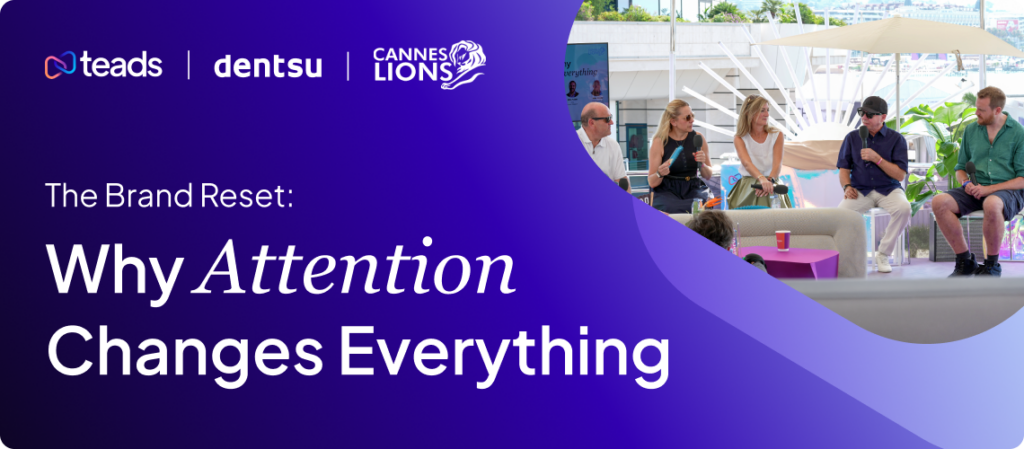
That tension shaped The Brand Reset: Why Attention Changes Everything by Teads during Cannes Lions, where Les Binet, author of The Long and the Short of It, Karen Owen, CMO Kraft Heinz Europe, Mike Follett, CEO of Lumen Research, and Anna Campbell Carat President joined me in exploring what happens when attention becomes the link between creative quality, media effectiveness, and long-term commercial growth.
Rebalancing the Long and the Short
Les Binet explained that performance marketing can generate “a very quick and immediate payback,” but “if you turn it off, it goes to zero almost immediately.” Brand building works differently because its effects “last much longer” and become “the main driver of growth and profit.”
For Binet, the industry’s mistake is treating those two jobs as alternatives. “The most important word in The Long and the Short of It is ‘and,’” he said.
Karen Owen shared how Kraft Heinz experienced that imbalance firsthand. “We’d really lost our way in terms of the longer-term brand building and emotional connection with consumers,” she said. Rebuilding growth required more investment, stronger creative, and smarter media planning because “you can have an investment reset, but if the creative isn’t strong, it’s not going to work.”
Proving Digital Video can Build Memory
Anna Campbell said The Brand Reset research by dentsu supported by Teads was designed to move marketers beyond “what click worked” and toward “what is actually moving brand and business.”
Mike Follett said the study asked whether digital video could create lasting memories, not just immediate response. “Can you drive long-term memories at all using these interesting digital formats?” he asked. “The answer is resoundingly yes.”
The more useful planning question, he added, is not whether attention matters, but how much is required to deliver the intended outcome. “The crucial word throughout all of this is ‘enough,’” Follett said.
Designing for the Medium, not Just Distributing into It
The panel also explored how CTV and digital can deliver brand effects close to linear television while offering more room for personalization and cross-screen storytelling.
Follett said marketers should not “throw away everything that we have learned over the last 75 years about how to make TV ads,” but they do need to adapt creative to each environment. Owen agreed that “the same piece will not work by just plastering it across different channels.”
The conversation then moved to the difference between forced exposure and earned attention. “If people give their attention rather than you steal it from them, they’re going to remember things,” Follett said.
Binet added that pulling people in with “great creative work, stuff that people just want to watch” is harder, but “in the long run twice as effective.” Follett argued that this makes creative a growth lever, not a production cost, because “the creative can double and triple and quadruple the value of your media.”
Key Takeaways
- Les Binet: Brand and performance work best together, and marketers should stop being “obsessed with efficiency at the expense of effectiveness.”
- Mike Follett: Marketers need “the right level of attention for the right price” in environments that invite engagement.
- Anna Campbell: Planning should start with “the desired brand business outcome” and then “engineer a growth system” around it.
- Karen Owen: Growth returned when Kraft Heinz reconnected “the 95 and 5,” increased investment, and rebuilt emotional connection with consumers.