

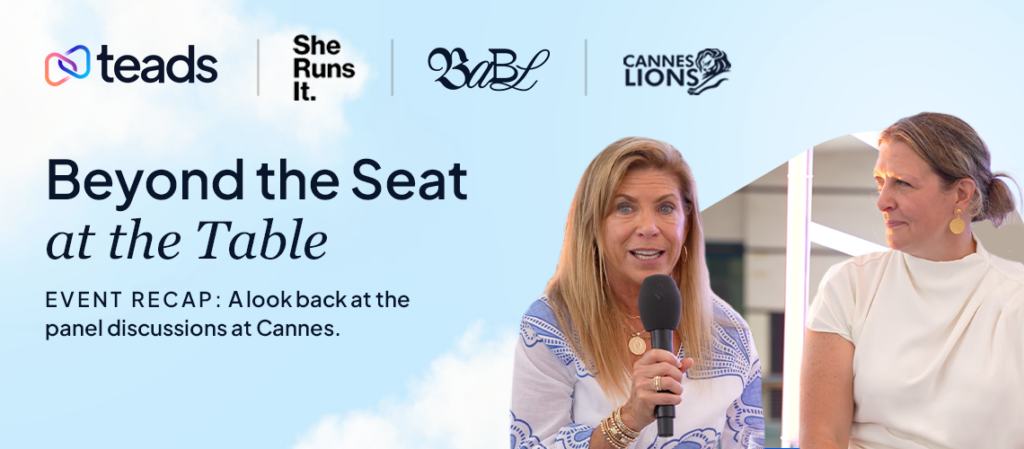
At Cannes Lions, conversations about women in leadership often begin with representation. Two sessions at The Bridge by Teads pushed the discussion further, asking what happens after women enter the room: Who gives them genuine authority? Who advocates for them when they are not present? And how can stronger partnerships translate individual progress into better business performance?
Hosted with She Runs It and BABL, She Runs It, He Gets It and The Business Case for Women in Leadership brought together executives from Teads, Zenith, Rocket Companies, Salesforce, iProspect, Amazon, dentsu, Scripps, Mediaplus, and Ziff Davis. Across both conversations, one idea stood out: allyship matters most when it moves beyond encouragement and begins changing access, decisions, and outcomes.
Leadership is Not Simply About Being in the Room
Opening the BABL session, Teads CEO David Kostman challenged organizations to look beyond representation. “It’s not only putting women in the room,” he said, “but putting them in impactful decision-making positions.” That distinction shaped a conversation centered not on symbolic visibility, but on the authority to influence strategy, allocate resources, and build businesses.
BABL founder Stephanie Vandenberg extended that argument to the wider ecosystem of opportunity. Officially launching BABL at Cannes, she described it as a prosperity platform focused on giving women access to C-suite and board roles, entrepreneurial funding, and early-stage investments. Her ambition was not only to help more women advance, but to create a community “about supporting one another, not competing with one another.”
The implication was direct: organizations cannot claim progress simply because women are visible. Progress requires giving them access to the networks, capital, authority, and opportunities through which leadership compounds.
Mentorship Offers Advice. Sponsorship Changes Trajectories.
A recurring theme across the panels was the difference between mentorship and sponsorship. As Vandenberg put it, “Mentors give you advice. Sponsors spend their political capital on you.”
That political capital can take many forms: recommending someone for a role before she appears to be the obvious choice, opening a door to a new discipline, defending a decision, or giving an emerging leader enough space to prove what she can do.
Scripps CRO Brian Norris described recognizing that Alison Morris had something exceptional even though she did not have a traditional advertising-sales background. Rather than hiring the safest candidate, he saw sponsorship as the responsibility to “unlock that thing that was special in her.” Morris later took a new commerce business from idea and strategy through execution, demonstrating why sponsorship is not charity. It is an investment in potential that conventional hiring criteria can overlook.
Yael Prough, President of Gaming and Entertainment at Ziff Davis, described a similar decision early in Tamara Alesi’s career. She could have chosen someone who already knew the role, but instead backed a candidate who was curious, energetic, and willing to challenge the organization. Looking at Alesi’s subsequent rise to CEO of Mediaplus, Prough called that decision “probably the best ROI that I’ve had through my career.”
The Strongest Partnerships Make Honesty Safer
During She Runs It, He Gets It, moderator Lynn Branigan, President and CEO of She Runs It, explored the working dynamics behind successful female and male “dynamic duos.” The partnerships differed in tenure, structure, and personality, but the strongest shared a foundation of trust.
Lauren Hanrahan, CEO of Zenith, explained that Rocket Companies CMO Jonathan Mildenhall creates space for radical honesty by beginning with gratitude. He recognizes what the team has achieved, acknowledges what has been difficult, and then challenges the work to become better. That sequence matters because people know they are valued before they are asked to confront what needs to change.
Mildenhall described psychological safety as the most important soft-skill contribution a client can make. Without it, he said, agency teams “shrink into a very small formal role.” When people know that “things might be bumpy, but we’re safe” and that the relationship remains solid, they are able to challenge, experiment, and produce more effective work.
Psychological safety did not mean avoiding tension. Across the panel, leaders repeatedly advocated for directness, constructive disagreement, and refusing to sugarcoat difficult messages. The difference is intent: honesty becomes productive when it is rooted in mutual respect and a shared commitment to the outcome.
Complementary Strengths are a Business Advantage
Mollie Spilman, Chief Commercial Officer at Teads, and Jeremy Helfand, Global Vice President and Head of Prime Video Advertising at Amazon, reflected on a partnership spanning more than two decades. Their working styles were different: Spilman brought a more creative perspective, while Helfand described himself as more analytical. Rather than treating those differences as friction to eliminate, they used them to improve their thinking.
Spilman recalled how their partnership between marketing and commercial leadership kept both teams focused on the customer rather than on their individual functions. Helfand said the experience taught him “the power of diversity of thought” and how bringing different strengths together can produce “really incredible outcomes.”
The same principle surfaced throughout both sessions. Effective allyship is about recognizing that the combination of different experiences, perspectives, and capabilities leads to better decisions than either person could reach alone.
From Good Intentions to Shared Accountability
The panels ultimately offered a more demanding definition of allyship. One as a pattern of action.
It means inviting someone into the room and ensuring their ideas can shape what happens there. It means hiring for potential rather than familiarity, sharing access rather than protecting it, and accepting personal risk when advocacy requires more than easy words. It also means aligning around shared goals, listening before solving, and following through on commitments so that trust can accumulate over time.
Women in leadership are not simply good for representation. They strengthen the collective intelligence of teams, introduce different approaches to decision-making, and create measurable commercial value. The business case is already clear. The challenge now is turning belief into behavior, so that women do not merely receive a seat at the table, but possess a genuine stake in the outcome.
Featured Speakers
- Lynn Branigan, President & CEO, She Runs It
- Lauren Hanrahan, Chief Executive Officer, Zenith
- Jonathan Mildenhall, Chief Marketing Officer, Rocket Companies
- Anika Kaulius, VP, Strategy, Operations & Performance, Salesforce
- Justin Claassen, EVP, Managing Director, iProspect
- Mollie Spilman, Chief Commercial Officer, Teads
- Jeremy Helfand, Global Vice President, Head of Amazon Prime Video Advertising, Amazon
- Christine Cotter, Managing Director, 360i and Head of Social Innovation, dentsu
- Phil Gaughran, CEO, Dentsu Creative Americas
- Dani Cushion, Chief Marketing Officer, Teads
- Alison Morris, VP, Revenue Strategy & Operations, Scripps
- Brian Norris, Chief Revenue Officer, Scripps
- Tamara Alesi, CEO, Mediaplus Group
- Yael Prough, President, Gaming and Entertainment, Ziff Davis